


Page 31 - Engineering Mathematics Workbook_Final
P. 31
Calculus
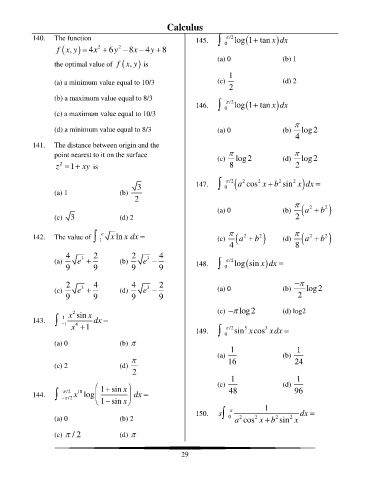
140. The function 145. 0 /2 log (1 tan x dx+ )
) 4x +
2
8
f ( , x y = 2 6y − 8x − 4y +
)
the optimal value of ( ,f x y is (a) 0 (b) 1
1
(a) a minimum value equal to 10/3 (c) (d) 2
2
(b) a maximum value equal to 8/3
146. 0 /2 log + )
(1 tan x dx
(c) a maximum value equal to 10/3
(d) a minimum value equal to 8/3 (a) 0 (b) log2
4
141. The distance between origin and the
point nearest to it on the surface (c) log2 (d) log2
+
z = 2 1 xy is 8 2
2
+
3 147. 0 /2 (a 2 cos x b 2 sin 2 ) x dx =
(a) 1 (b)
2
2
(a) 0 (b) (a + b 2 )
(c) 3 (d) 2 2
2
2
142. The value of 1 e x ln x dx = (c) (a + b 2 ) (d) (a + b 2 )
4 8
4 2 2 4
3
3
)
(a) e + (b) e − 148. 0 /2 log (sin x dx =
9 9 9 9
2 4 4 2 −
3
3
(c) e + (d) e − (a) 0 (b) log2
9 9 9 9 2
143. − 1 1 x 2 4 sin x dx = (c) − log2 (d) log2
x +
1
5
3
149. 0 /2 sin x cos xdx =
(a) 0 (b)
1 1
(a) 16 (b) 24
(c) 2 (d)
2
1 1
+ (c) (d)
/2 10 1 sin x 48 96
144. − /2 x log dx =
−
1 sin x 1
150. s 0 dx =
+
(a) 0 (b) 2 a 2 cos x b 2 sin x
2
2
(c) / 2 (d)
29

