


Page 24 - NCJA Journal_volume1_issue1-final
P. 24
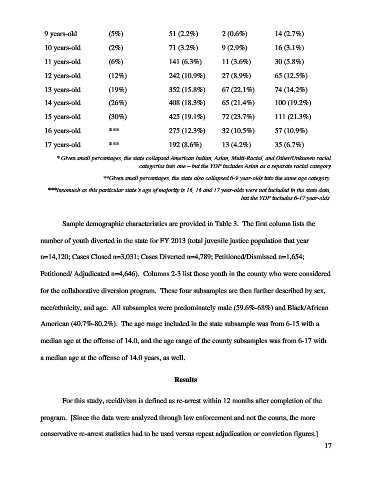
9 years-old           (5%)                51 (2.2%)        2 (0.6%)          14 (2.7%)

               10 years-old          (2%)                71 (3.2%)        9 (2.9%)          16 (3.1%)

               11 years-old          (6%)                141 (6.3%)       11 (3.6%)         30 (5.8%)

               12 years-old          (12%)               242 (10.9%)      27 (8.9%)         65 (12.5%)

               13 years-old          (19%)               352 (15.8%)      67 (22.1%)        74 (14.2%)
               14 years-old          (26%)               408 (18.3%)      65 (21.4%)        100 (19.2%)

               15 years-old          (30%)               425 (19.1%)      72 (23.7%)        111 (21.3%)

               16 years-old          ***                 275 (12.3%)      32 (10.5%)        57 (10.9%)

               17 years-old          ***                 192 (8.6%)       13 (4.2%)         35 (6.7%)

                    * Given small percentages, the state collapsed American Indian, Asian, Multi-Racial, and Other/Unknown racial
                                               categories into one – but the YDP includes Asian as a separate racial category
                                   **Given small percentages, the state also collapsed 6-9 year-olds into the same age category.

                 ***Insomuch as this particular state’s age of majority is 16, 16 and 17 year-olds were not included in the state data,
                                                                                 but the YDP includes 6-17 year-olds.


                      Sample demographic characteristics are provided in Table 3.  The first column lists the


              number of youth diverted in the state for FY 2013 (total juvenile justice population that year

              n=14,120; Cases Closed n=3,031; Cases Diverted n=4,789; Petitioned/Dismissed n=1,654;


              Petitioned/ Adjudicated n=4,646).  Columns 2-3 list those youth in the county who were considered

              for the collaborative diversion program.  These four subsamples are then further described by sex,

              race/ethnicity, and age.  All subsamples were predominately male (59.6%-68%) and Black/African


              American (40.7%-80.2%).  The age range included in the state subsample was from 6-15 with a

              median age at the offense of 14.0, and the age range of the county subsamples was from 6-17 with


              a median age at the offense of 14.0 years, as well.


                                                           Results


                      For this study, recidivism is defined as re-arrest within 12 months after completion of the

              program.  [Since the data were analyzed through law enforcement and not the courts, the more


              conservative re-arrest statistics had to be used versus repeat adjudication or conviction figures.]
                                                                                                            17

