


Page 90 - test2
P. 90
VII.       Temporary Abandonment of the Macondo Well


                          At the end of drilling operations, the rig crew needs to secure the well
                   prior to leaving the site.  “Temporary abandonment” refers to the process by
                   which the rig crew installs cement plugs in the well and pulls the riser and
                   blowout preventer to the surface to move to another location.  Pressure testing
                   (called positive and negative tests) is a key component of temporary
                   abandonment procedures because it seeks to ensure well integrity and that
                   hydrocarbons are not leaking into the well.

                              A.     Installing the Lock‐Down Sleeve

                          BP’s planned temporary abandonment procedures for the Macondo well
                   were not completed until April 12, and subsequently changed a number of times
                   before April 20.  The initial plan included the setting of a lock‐down sleeve prior
                   to displacing drilling mud from the riser.

                          Temporary abandonment procedures do not always include installation of
                   a lock‐down sleeve.  Correspondence from late 2009 and early 2010 shows that
                   BP decided to install the lock‐down sleeve as part of its temporary abandonment
                   procedures on the Macondo well to save costs.  In January 2010, Merrick Kelley,
                   BP subsea wells team leader, exchanged a number of emails with BP drilling
                   engineer Mark Hafle about the installation of a lock‐down sleeve by the
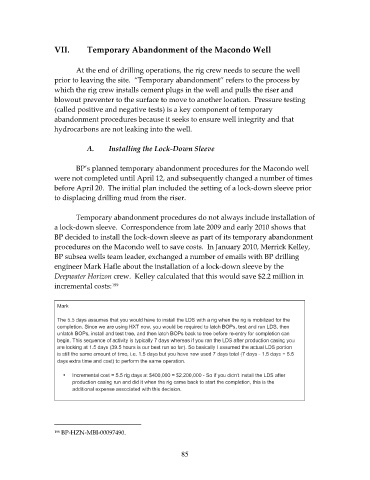
                   Deepwater Horizon crew.  Kelley calculated that this would save $2.2 million in
                                      199
                   incremental costs:


                   199  BP‐HZN‐MBI‐00097490.


                                                             85

