


Page 301 - Robot Design Handbook ROBOCON Malaysia 2019
P. 301
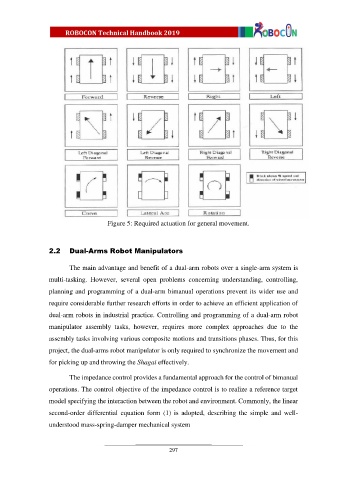
Figure 5: Required actuation for general movement.


                  2.2    Dual-Arms Robot Manipulators


                         The main advantage and benefit of a dual-arm robots over a single-arm system is
                  multi-tasking.  However,  several  open  problems  concerning  understanding,  controlling,

                  planning and programming of a dual-arm bimanual operations prevent its wider use and

                  require considerable further research efforts in order to achieve an efficient application of
                  dual-arm robots in industrial practice. Controlling and programming of a dual-arm robot

                  manipulator  assembly  tasks,  however,  requires  more  complex  approaches  due  to  the
                  assembly tasks involving various composite motions and transitions phases. Thus, for this

                  project, the dual-arms robot manipulator is only required to synchronize the movement and
                  for picking up and throwing the Shagai effectively.


                         The impedance control provides a fundamental approach for the control of bimanual
                  operations. The control objective of the impedance control is to realize a reference target

                  model specifying the interaction between the robot and environment. Commonly, the linear

                  second-order  differential  equation  form  (1)  is  adopted,  describing  the  simple  and  well-
                  understood mass-spring-damper mechanical system


                                                            297

