


Page 297 - Robot Design Handbook ROBOCON Malaysia 2019
P. 297
demanding  autonomous  mobile  robots  to  fulfil  various  movement  tasks  [2,3].  Due  to

                  complicated working environment, mobile robots need to be flexible, adaptive, and safe
                  [4,5]. There are many kinds of omni-directional mobile robots that have been developed and

                  produced [6]. Two common types of wheels that can realize the omni-directional movement
                  are the steerable wheel and the omni-directional wheel. Both of them have been used for

                  mature products, including Adept Seekur and KUKA omniRob robots.

                         Dual-arms robot manipulators are more capable of implementing complex tasks as

                  compared to a single arm manipulator robot. The advantages and benefits of dual arm robots

                  over a single arm manipulator system are multitasking, cost saving and space saving. This
                  technical report addresses the design of a nine DOF dual arms mobile robot manipulators.

                  There  are  many  kinds  of  omni-directional  mobile  robots  that  have  been  developed  and
                  produced [2]. Thus the team integrated the dual-arms robot with an omni-directional mobile

                  robot to design a nine DOF dual-arms omni-directional mobile robot.

                         The  development  for  this  project  can  be  divided  into  two  major  stages;  the

                  mechanical design for omni-driectional mobile robot and the dual-arm robot manipulator
                  design.


                  2.1    Omni-Directional Mobile Robot

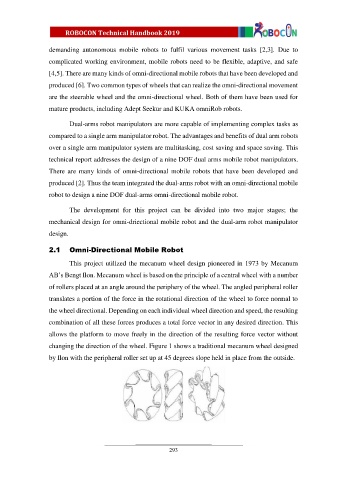
                         This project utilized the mecanum wheel design pioneered in 1973 by Mecanum

                  AB’s Bengt Ilon. Mecanum wheel is based on the principle of a central wheel with a number
                  of rollers placed at an angle around the periphery of the wheel. The angled peripheral roller

                  translates a portion of the force in the rotational direction of the wheel to force normal to
                  the wheel directional. Depending on each individual wheel direction and speed, the resulting

                  combination of all these forces produces a total force vector in any desired direction. This
                  allows the platform to move freely in the direction of the resulting force vector without

                  changing the direction of the wheel. Figure 1 shows a traditional mecanum wheel designed

                  by Ilon with the peripheral roller set up at 45 degrees slope held in place from the outside.


                                                            293

