


Page 84 - Robot Design Handbook ROBOCON Malaysia 2019
P. 84
iii. Control of Mobile Robot
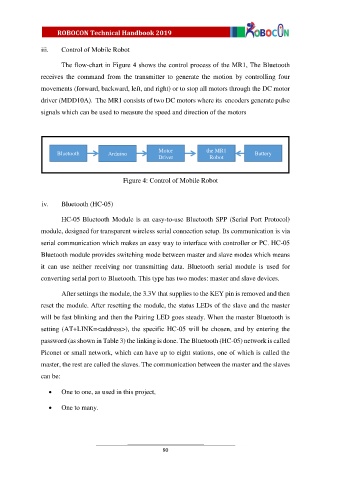
The flow-chart in Figure 4 shows the control process of the MR1, The Bluetooth
receives the command from the transmitter to generate the motion by controlling four
movements (forward, backward, left, and right) or to stop all motors through the DC motor
driver (MDD10A). The MR1 consists of two DC motors where its encoders generate pulse
signals which can be used to measure the speed and direction of the motors
Bluetooth Arduino Motor the MR1 Battery
Driver Robot
Figure 4: Control of Mobile Robot
iv. Bluetooth (HC-05)
HC-05 Bluetooth Module is an easy-to-use Bluetooth SPP (Serial Port Protocol)
module, designed for transparent wireless serial connection setup. Its communication is via
serial communication which makes an easy way to interface with controller or PC. HC-05
Bluetooth module provides switching mode between master and slave modes which means
it can use neither receiving nor transmitting data. Bluetooth serial module is used for
converting serial port to Bluetooth. This type has two modes: master and slave devices.
After settings the module, the 3.3V that supplies to the KEY pin is removed and then
reset the module. After resetting the module, the status LEDs of the slave and the master
will be fast blinking and then the Pairing LED goes steady. When the master Bluetooth is
setting (AT+LINK=<address>), the specific HC-05 will be chosen, and by entering the
password (as shown in Table 3) the linking is done. The Bluetooth (HC-05) network is called
Piconet or small network, which can have up to eight stations, one of which is called the
master, the rest are called the slaves. The communication between the master and the slaves
can be:
One to one, as used in this project,
One to many.
80

