


Page 20 - Drug Discovery and Development: Prospects and Challenges
P. 20
10  /  Drug Discovery and Development: Prospects and Challenges

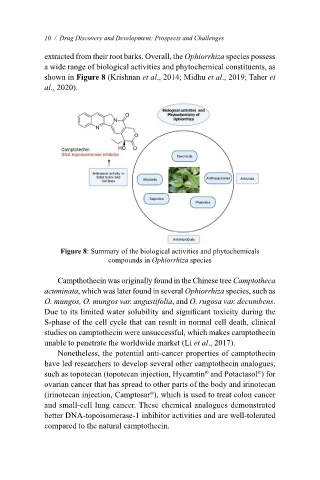
             extracted from their root barks. Overall, the Ophiorrhiza species possess
             a wide range of biological activities and phytochemical constituents, as
             shown in Figure 8 (Krishnan et al., 2014; Midhu et al., 2019; Taher et
             al., 2020).


                 Figure 8: Summary of the biological activities and phytochemicals
                              compounds in Ophiorrhiza species

                 Campthothecin was originally found in the Chinese tree Camptotheca
             acuminata, which was later found in several Ophiorrhiza species, such as
             O. mungos, O. mungos var. angustifolia, and O. rugosa var. decumbens.
             Due to its limited water solubility and significant toxicity during the
             S-phase of the cell cycle that can result in normal cell death, clinical
             studies on camptothecin were unsuccessful, which makes camptothecin
             unable to penetrate the worldwide market (Li et al., 2017).
                 Nonetheless, the potential anti-cancer properties of camptothecin
             have led researchers to develop several other camptothecin analogues,
             such as topotecan (topotecan injection, Hycamtin  and Potactasol ) for
                                                                       ®
                                                        ®
             ovarian cancer that has spread to other parts of the body and irinotecan
             (irinotecan injection, Camptosar ), which is used to treat colon cancer
                                          ®
             and small-cell lung cancer. These chemical analogues demonstrated
             better DNA-topoisomerase-1 inhibitor activities and are well-tolerated
             compared to the natural camptothecin.

