


Page 21 - Drug Discovery and Development: Prospects and Challenges
P. 21
Drug Discovery and Development: Prospects and Challenges  /  11

                 The high demand for camptothecin analogues in the market from
             USD 3,500 to USD 50,000 per kilogram has inspired researchers to
             produce its callus culture. The production of camptothecin analogues
             has been developed using the plant culture propagation technique. In
             vitro propagation of O. mungos recorded the production of camptothecin
             compared to naturally grown O. mungos, proving that the culture
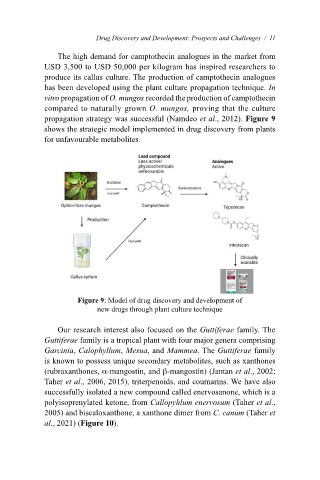
             propagation strategy was successful (Namdeo et al., 2012). Figure 9
             shows the strategic model implemented in drug discovery from plants
             O. mungos recorded the production of camptothecin compared to naturally grown O. mungos, proving
             that the  culture propagation  strategy was  successful  (Namdeo  et al., 2012).  Figure  9  shows  the
             for unfavourable metabolites.
             strategic model implemented in drug discovery from plants for unfavourable metabolites.


                      Figure 9: Model of drug discovery and development of
             Figure 9: Model of drug discovery and development of new drugs through plant culture technique
                           new drugs through plant culture technique
                 Our research interest also focused on the Guttiferae family. The Guttiferae family is a tropical
                 Our research interest also focused on the Guttiferae family. The

             plant with four major genera comprising Garcinia, Calophyllum, Mesua, and Mammea. The Guttiferae
             Guttiferae family is a tropical plant with four major genera comprising
             family is  known  to possess unique  secondary metabolites,  such as  xanthones (rubraxanthones, a-
             mangostin,  and  b-mangostin)  (Jantan  et al., 2002; Taher  et al., 2006, 2015),  triterpenoids,  and
             Garcinia, Calophyllum, Mesua, and Mammea. The Guttiferae family
             coumarins.  We  have also successfully  isolated  a new compound called  enervosanone, which  is a
             is known to possess unique secondary metabolites, such as xanthones
             polyisoprenylated ketone, from Callopyhlum enervosum (Taher et al., 2005) and biscaloxanthone, a
             (rubraxanthones, a-mangostin, and b-mangostin) (Jantan et al., 2002;
             xanthone dimer from C. canum (Taher et al., 2021) (Figure 10).
             Taher et al., 2006, 2015), triterpenoids, and coumarins. We have also

             successfully isolated a new compound called enervosanone, which is a
             polyisoprenylated ketone, from Callopyhlum enervosum (Taher et al.,
             2005) and biscaloxanthone, a xanthone dimer from C. canum (Taher et
             al., 2021) (Figure 10).

                                                                     16

