


Page 24 - Drug Discovery and Development: Prospects and Challenges
P. 24
14  /  Drug Discovery and Development: Prospects and Challenges

             Brothers and sisters,
             Ladies and Gentlemen,


                                 Anti-cancer/Cytotoxicity
             Various cytotoxic and anti-cancer studies have used 4,5-dimethylthiazol-
             2-yl)-2,5-diphenyltetrazolium bromide (MTT) and its improved MTS
             assay. Firstly introduced by Mossman in 1983, the MTT assay uses
             mitochondrial reductase enzymes produced by live cells to convert MTT
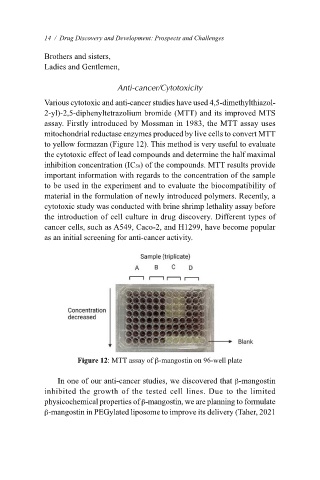
             to yellow formazan (Figure 12). This method is very useful to evaluate
             the cytotoxic effect of lead compounds and determine the half maximal
             inhibition concentration (IC50) of the compounds. MTT results provide
             important information with regards to the concentration of the sample
             to be used in the experiment and to evaluate the biocompatibility of
             material in the formulation of newly introduced polymers. Recently, a
             cytotoxic study was conducted with brine shrimp lethality assay before
             the introduction of cell culture in drug discovery. Different types of
             cancer cells, such as A549, Caco-2, and H1299, have become popular
             as an initial screening for anti-cancer activity.


                      Figure 12: MTT assay of b-mangostin on 96-well plate

                 In one of our anti-cancer studies, we discovered that b-mangostin
             inhibited the growth of the tested cell lines. Due to the limited
             physicochemical properties of b-mangostin, we are planning to formulate
             b-mangostin in PEGylated liposome to improve its delivery (Taher, 2021

