


Page 23 - GeoPRISMS_Newsletter_Spring2018_Neat
P. 23
C             175E        186E  31S
        Importantly, this perspective will help to elucidate a clearer   Australia
                                                               Australian Plate  Kermadec Tr.  .  Kermadec Trench  0  50  100  150  200  35S
        picture of megathrust earthquake and tsunami hazards along   s tra lia                               km
        New Zealand’s Hikurangi margin.                            Pacic Plate    45 mm/a
                                                                B    North Island
        The SHIRE Project has three principal components:             Mt Taranaki
                                                            40S                  Hikurangi
        1.   Geophysical imaging: Harm van Avendonk (UT Austin)                  Plateau
        and David Okaya (Univ. of Southern California) are leading the   Alpine Fault  Chatham Rise  Chatham   Kermadec Trench  37S
                                                                                 Islands
        shoreline-crossing geophysical imaging investigations. Marine   35 mm/a  South Island                    Sediment starved
        seismic multi-channel reflection data (MCS) and seismic
        refraction data recorded by ocean-bottom seismometers (OBSs)   49S  0        200      400            avalanche
                                                                        kilometers
                                                                                                             Ruatoria
        are being used to characterize the incoming Hikurangi Plateau,   A                                    0
                                                                                               PENINSULA
        map the structure of the offshore accretionary prism, and                Back arc extension  RAUKUMARA Gisborne  1
                                                                                                               & tectonic erosion
                                                                              A    TVZ            05CM-04  Poverty
        document subducted sediment variations. Onshore recordings                                        Seavalleys  39S
        of offshore airgun shots, explosive shots, and local earthquakes will   Mt Taranaki  Hawke LR    Hikurangi Subducted seamounts
                                                                                             Bay
        determine the structure of the upper plate and properties of the               Napier  KR  05CM-01  Channel
        deeper plate boundary zone.                                                NIDFB              A' 2  43  0
                                                                    Australian Plate
        2.   Paleoseismology and morphotectonics: Paleoseismic and                                      0
        geomorphic studies led by Jeff Marshall (Cal Poly Pomona) and                   05CM-38
        Jessica Pilarczyk (Univ. of Southern Mississippi) will collect new        WAIRARAPA         2                 41S
        field data to supplement ongoing coastal tectonics investigations   Cook Wellington    Trough Frontal accretion  PACIFIC
                                                                                                            PLATE
                                                                                                   1
        conducted by collaborators at New Zealand’s GNS Science. This    Strait             3      0  dominant Hikurangi Plateau
        integrated data set will help resolve megathrust slip behavior over   6  Hikurangi 2 Hikurangi    Axial
                                                                                 5
                                                                                 4
                                                                                   3
        several seismic cycles, and constrain long-term coastal uplift and   5  1 Channel  0  1   Backarc domain ranges  Forearc domain Hikurangi
                                                                                                    Volcanic arc
                                                                             0                   D           Coast  Trough  0
        subsidence patterns. This component of the project includes a                                              42 mm.yr -1
        Research Experience for Undergraduates (REU) program, supervised                          AUSTRALIAN    PACIFIC PLATE  40
                                                                                                  PLATE
                                                                                                                         80
        by Marshall, that engages US students in collaborative New Zealand        Chatham Rise     300   200   100    0  km
        fieldwork.                                                 174E         176E        178E         180
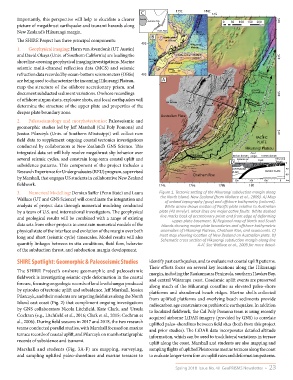
        3.   Numerical Modelling: Demian Saffer (Penn State) and Laura   Figure 1. Tectonic setting of the Hikurangi subduction margin along
        Wallace (UT and GNS Science) will coordinate the integration and   the North Island, New Zealand (from Wallace et al., 2009). A) Map
                                                                      of onland topography (gray) and offshore bathymetry (colored).
        analysis of project data through numerical modeling conducted   White arrow shows motion of Pacific plate relative to Australian
        by a team of U.S. and international investigators. The geophysical   plate (43 mm/yr). Black lines are major active faults. White dashed
        and geological results will be combined with a range of existing   line marks back of accretionary prism and front edge of deforming
                                                                         upper-plate basement. B) Regional map of North and South
        data sets from other projects to constrain numerical models of the   Islands showing major plate boundaries and offshore bathymetric
        physical state of the interface and evolution of the margin over both   anomalies of Hikurangi Plateau, Chatham Rise, and seamounts. C)
        long and short (seismic cycle) timescales. Model results will also   Inset map showing location of New Zealand on Australian plate. D)
                                                                    Schematic cross section of Hikurangi subduction margin along line
        quantify linkages between in situ conditions, fluid flow, behavior          A-A’. See Wallace et al., 2009 for more detail.
        of the subduction thrust, and subduction margin development.
        SHIRE Spotlight: Geomorphic & Paleoseismic Studies     identify past earthquakes, and to evaluate net coastal uplift patterns.
                                                               Their efforts focus on several key locations along the Hikurangi
        The SHIRE Project’s onshore geomorphic and paleoseismic   margin, including the Raukumaura Peninsula, southern Hawkes Bay,
        fieldwork is investigating seismic cycle deformation in the coastal   and central Wairarapa coast. Coseismic uplift events are preserved
        fore arc, focusing on geologic records of land level changes produced   along much of the Hikurangi coastline as elevated paleo-shore
        by episodes of tectonic uplift and subsidence. Jeff Marshall, Jessica   platforms and abandoned beach ridges. Marine shells collected
        Pilarczyk, and their students are targeting field sites along the North   from uplifted platforms and overlying beach sediments provide
        Island east coast (Fig. 2) that compliment ongoing investigations   radiocarbon age constraints on prehistoric earthquakes. In addition
        by GNS collaborators Nicola Litchfield, Kate Clark, and Ursula   to localized fieldwork, the Cal Poly Pomona team is using recently
        Cochran (e.g., Litchfield et al., 2016; Clark et al., 2015; Cochran et   acquired airborne LiDAR imagery (provided by GNS) to correlate
        al., 2006). During field seasons in 2017 and 2018, the two research   uplifted paleo-shorelines between field sites (both from this project
        teams conducted parallel studies, with Marshall focused on marine   and prior studies). The LiDAR data incorporates detailed altitude
        terrace records of coastal uplift, and Pilarczyk on marsh stratigraphic   information, which can be used to track lateral variations in terrace
        records of subsidence and tsunami.                     uplift along the coast. Marshall and students are also mapping and
        Marshall and students (Fig. 3A-F) are mapping, surveying,   sampling flights of uplifted Pleistocene marine terraces along the coast
        and sampling uplifted paleo-shorelines and marine terraces to   to evaluate longer-term fore arc uplift rates and deformation patterns.

                                                                          Spring 2018  Issue No. 40  GeoPRISMS Newsletter  •  23

