


Page 14 - GeoPRISMS_Newsletter_Spring2018_Neat
P. 14
The NZ3D Experiment – Adding a new

        dimension for understanding slow slip events


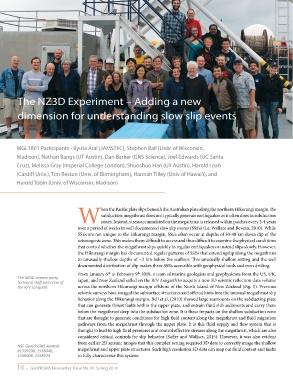
        MGL1801 Participants - Ryuta Aral (JAMSTEC), Stephen Ball (Univ. of Wisconsin,
        Madison), Nathan Bangs (UT Austin), Dan Barker (GNS Science), Joel Edwards (UC Santa
        Cruz), Melissa Gray (Imperial College London), Shuoshuo Han (UT Austin), Harold Leah
        (Cardiff Univ.), Tim Reston (Univ. of Birmingham), Hannah Tilley (Univ of Hawai’i), and

        Harold Tobin (Univ. of Wisconsin, Madison)


                                           hen the Pacific plate slips beneath the Australian plate along the northern Hikurangi margin, the
                                           subduction megathrust does not typically generate earthquakes as it often does in subduction
                                  Wzones. Instead, stress accumulated on the megathrust is released within patches every 2-4 years
                                  over a period of weeks in well documented slow slip events (SSEs) (i.e. Wallace and Bevean, 2010). While
                                  SSEs are not unique to the Hikurangi margin, SSEs often occur at depths of 30-40 km down dip of the
                                  seismogenic zone. This makes them difficult to access and thus difficult to examine the physical conditions
                                  that control whether the megathrust slips quickly in regular earthquakes or instead slips slowly. However,
                                  the Hikurangi margin has documented regular patterns of SSEs that extend updip along the megathrust
                                  to unusually shallow depths of ~2 km below the seafloor. This unusually shallow setting and the well
                                  documented distribution of slip makes these SSEs accessible with geophysical tools and even drilling.
                                  From January 6  to February 9  2018, a team of marine geologists and geophysicists from the US, UK,
                                                           th
                                              th
        The NZ3D science party,
        technical staff and crew of   Japan, and New Zealand sailed on the R/V Langseth to acquire a new 3D seismic reflection data volume
        the R/V Langseth.         across the northern Hikurangi margin offshore of the North Island of New Zealand (Fig. 1). Previous
                                  seismic surveys have imaged the subsurface structures and offered hints into the unusual megathrust slip
                                  behavior along the Hikurangi margin. Bell et al. (2010) showed large seamounts on the subducting plate
                                  that can generate thrust faults within the upper plate, and entrain fluid rich sediments and carry them
                                  below the megathrust deep into the subduction zone. It is these impacts on the shallow subduction zone
                                  that are thought to generate conditions for high fluid content along the megathrust and fluid migration
                                  pathways from the megathrust through the upper plate. It is this fluid supply and flow system that is
                                  thought to lead to high fluid pressures and control effective stresses along the megathrust, which are also
                                  considered critical controls for slip behavior (Saffer and Wallace, 2015). However, it was also evident
                                  from earlier 2D seismic images that this complex setting required 3D data to correctly image the shallow
        NSF GeoPRISMS Awards
        #1559298, 1558440,        megathrust and upper plate structures. Such high resolution 3D data can map out fluid content and faults
        1559008, 1558574          to fully characterize this system.

        14  •  GeoPRISMS Newsletter  Issue No. 40  Spring 2018

