


Page 13 - GeoPRISMS_Newsletter_Spring2018_Neat
P. 13
178°E
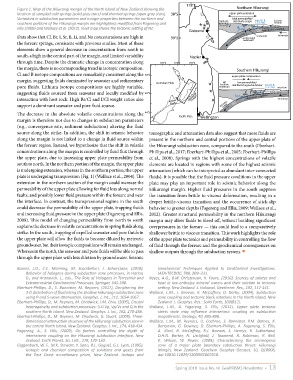
        Figure 1. Map of the Hikurangi margin of the North Island of New Zealand showing the        Northern Hikurangi
        location of sampled cold springs (solid gray stars) and thermal springs (open gray stars).  38°S  upper plate extension
        Variations in subduction parameters and margin properties between the northern and   back-arc  high permeability/  high [Cl, B,  tectonic
        southern portions of the Hikurangi margin are highlighted; modified from Fagereng and   extension  slab uids escape  Li, Sr, Na]  erosion
        Ellis (2009) and Wallace et al. (2012). Inset map shows the tectonic setting of NZ.          uids
                                                                                Gisborne                    SSEs interseismic coupling
        Data show that Cl, Br, I, Sr, B, Li, and Na concentrations are high in   39°S             aseismic creep underplated  seamount  60 mm/yr
        the forearc springs, consistent with previous studies. Most of these                           sediment?
        elements show a general decrease in concentration from north to
        south, a high in the central part of the margin, and limited variability   Napier
        through time. Despite the dramatic change in concentration along   170°E  174°E  178°E
        the margin, there is no corresponding trend in isotopic composition.                        Southern Hikurangi
        Cl and B isotope compositions are remarkably consistent along the 36°S                    upper plate compression
        margin, suggesting fluids dominated by seawater and sedimentary   Australian Plate    NO    low permeability/
                                                                                             back-arc
        pore fluids. Lithium isotope compositions are highly variable,                       extension  slab uids trapped & diluted  low [Cl, B,  accretion
                                                                                                                Li, Sr, Na]
        suggesting fluids sourced from seawater and locally modified by  40°S                      uids
                                                                                 Trough
        interaction with host rock. High Br/Cl and I/Cl weight ratios also   Alpine  Hikurangi          interseismic coupling  20 mm/yr
        support a dominant seawater and pore fluid source.              Fault                aseismic  SSEs
                                                                                              creep
        The decrease in the absolute volatile concentrations along the  44°S  Pacic Plate
        margin is therefore not due to changes in subduction parameters              Wellington
        (e.g., convergence rate, sediment subduction) altering the fluid
        source along the strike. In addition, the shift in seismic behavior  tomographic and attenuation data also suggest that more fluids are
        along the margin is not linked to a change in fluid source within  present in the northern and central portions of the upper plate of
        the forearc region. Instead, we hypothesize that the shift in volatile  the Hikurangi subduction zone, compared to the south (Eberhart-
        concentrations along the margin is controlled by fluid flux through  Phillips et al., 2017; Eberhart-Phillips et al., 2005; Eberhart-Phillips
        the upper plate, due to increasing upper plate permeability from  et al., 2008). Springs with the highest concentrations of volatile
        south to north. In the northern portion of the margin, the upper plate  elements are located in regions with some of the highest seismic
        is undergoing extension, whereas in the southern portion, the upper  attenuation (which can be interpreted as abundant inter-connected
        plate is undergoing transpression (Fig. 1) (Wallace et al., 2004). The  fluids). It is possible that the fluid pressure conditions in the upper
        extension in the northern section of the margin could increase the  plate may play an important role in seismic behavior along the
        permeability of the upper plate allowing for fluid loss along normal  Hikurangi margin. Higher fluid pressures in the south suppress
        faults, and possibly lower fluid pressure within the forearc and near  the transition from brittle to viscous deformation, resulting in a
        the interface. In contrast, the transpressional regime in the south  deeper brittle-viscous transition and the occurrence of stick-slip
        could decrease the permeability of the upper plate, trapping fluids  behavior to greater depths (Fagereng and Ellis, 2009; Wallace et al.,
        and increasing fluid pressure in the upper plate (Fagereng and Ellis,  2012). Greater structural permeability in the northern Hikurangi
        2009). This model of changing permeability from north to south  margin may allow fluids to bleed off, without building significant
        explains the decrease in volatile concentrations in spring fluids along  overpressures in the forearc — this could lead to a comparatively
        strike. In the south, trapping of expelled seawater and pore fluids in  shallower brittle to viscous transition. This work highlights the role
        the upper plate will allow the fluids to become diluted by meteoric  of the upper plate tectonics and permeability in controlling the flow
        groundwater, but their isotopic compositions will remain unchanged.  of fluid through the forearc and the geochemical consequences on
        Whereas in the north, the seawater and pore fluids will be able to pass  shallow outputs through the subduction system. ■
        through the upper plate with less dilution by groundwater. Seismic

        Barnes,  J.D.,  C.E.  Manning,  M.  Scambelluri,  J.  Selverstone,  (2018),   Geochemical  Techniques  Applied  to  Geothermal  Investigations.
            Behavior of halogens during subduction zone processes, in Harlov,   IAEA-TECDOC, 788, 209–231.
            D., and Aranovich, L., eds., The Role of Halogens in Terrestrial and   Reyes, A.G., B.W. Christenson, K. Faure, (2010), Sources of solutes and
            Extraterrestrial Geochemical Processes, Springer, 545-590.  heat in low-enthalpy mineral waters and their relation to tectonic
        Eberhart-Phillips,  D.,  S.  Bannister,  M.  Reyners,  (2017),  Deciphering  the   setting, New Zealand. J. Volcanol. Geotherm. Res., 192, 117-141.
            3-D distribution of fluid along the shallow Hikurangi subduction zone   Wallace,  L.M.,  J.  Beavan,  R.  McCaffrey,  D.  Darby,  (2004),  Subduction
            using P-and S-wave attenuation. Geophys. J. Int., 211, 1054-1067.  zone coupling and tectonic block rotations in the North Island, New
        Eberhart-Phillips, D., M. Reyners, M. Chadwick, J.M. Chiu, (2005), Crustal   Zealand. J. Geophys. Res.: Solid Earth, 109(B12).
            heterogeneity and subduction processes: 3-D Vp, Vp/Vs and Q in the   Wallace,  L.M.,  A.  Fagereng,  S.  Ellis,  (2012),  Upper  plate  tectonic
            southern North Island, New Zealand. Geophys. J. Int., 162, 270-288.  stress  state  may  influence  interseismic  coupling  on  subduction
        Eberhart-Phillips, D., M. Reyners, M. Chadwick, G. Stuart, (2008), Three-  megathrusts. Geology, 40, 895-898.
            dimensional attenuation structure of the Hikurangi subduction zone in   Wallace,  L.M.,  M.  Reyners,  U.  Cochran,  S.  Bannister,  P.M.  Barnes,  K.
            the central North Island, New Zealand. Geophys. J. Int., 174, 418-434.  Berryman,  G.  Downes,  D.  Eberhart-Phillips,  A.  Fagereng,  S.  Ellis,
        Fagereng,  A.,  S.  Ellis,  (2009),  On  factors  controlling  the  depth  of   A.  Nicol,  R.  McCaffrey,  R.J.  Beavan,  S.  Henrys,  R.  Sutherland,
            interseismic  coupling  on  the  Hikurangi  subduction  interface,  New   D.H.N.  Barker,  N.  Litchfield,  J.  Townend,  R.  Robinson,  R.  Bell,
            Zealand. Earth Planet. Sci. Lett., 278, 120-130.       K.  Wilson,  W.  Power,  (2009),  Characterizing  the  seismogenic
        Giggenbach, W. F., M.K. Stewart, Y. Sano, R.L. Goguel, G.L. Lyon, (1995),   zone  of  a  major  plate  boundary  subduction  thrust:  Hikurangi
            Isotopic  and  chemical  composition  of  solutions  and  gases  from   Margin,  New  Zealand.  Geochem  Geophys  Geosyst,  10,  Q10006,
            the  East  Coast  accretionary  prism,  New  Zealand.  Isotope  and   doi:10010.11029/12009GC002610.

                                                                          Spring 2018  Issue No. 40  GeoPRISMS Newsletter  •  13

