


Page 17 - 100 - HR Management Manual
P. 17
The following are the basics of filing and organizing:


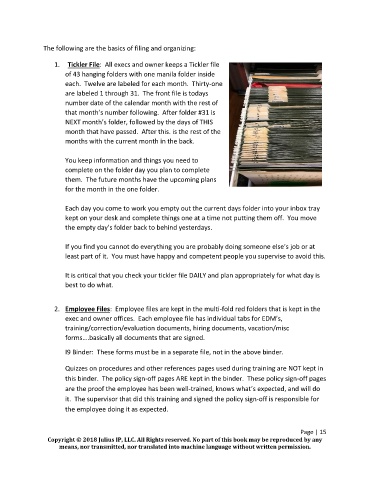
                   1.   Tickler File:  All execs and owner keeps a Tickler file
                       of 43 hanging folders with one manila folder inside
                       each.  Twelve are labeled for each month.  Thirty-one
                       are labeled 1 through 31.  The front file is todays
                       number date of the calendar month with the rest of
                       that month’s number following.  After folder #31 is
                       NEXT month’s folder, followed by the days of THIS
                       month that have passed.  After this. is the rest of the
                       months with the current month in the back.

                       You keep information and things you need to
                       complete on the folder day you plan to complete
                       them.  The future months have the upcoming plans
                       for the month in the one folder.

                       Each day you come to work you empty out the current days folder into your inbox tray
                       kept on your desk and complete things one at a time not putting them off.  You move
                       the empty day’s folder back to behind yesterdays.

                       If you find you cannot do everything you are probably doing someone else’s job or at
                       least part of it.  You must have happy and competent people you supervise to avoid this.

                       It is critical that you check your tickler file DAILY and plan appropriately for what day is
                       best to do what.


                   2.  Employee Files:  Employee files are kept in the multi-fold red folders that is kept in the
                       exec and owner offices.  Each employee file has individual tabs for EDM’s,
                       training/correction/evaluation documents, hiring documents, vacation/misc
                       forms….basically all documents that are signed.


                       I9 Binder:  These forms must be in a separate file, not in the above binder.

                       Quizzes on procedures and other references pages used during training are NOT kept in
                       this binder.  The policy sign-off pages ARE kept in the binder.  These policy sign-off pages

                       are the proof the employee has been well-trained, knows what’s expected, and will do
                       it.  The supervisor that did this training and signed the policy sign-off is responsible for
                       the employee doing it as expected.


                                                                                                    Page | 15
                 Copyright © 2018 Julius IP, LLC. All Rights reserved. No part of this book may be reproduced by any
                     means, nor transmitted, nor translated into machine language without written permission.

