


Page 14 - analysis-and-interpretation-of-astronomical-sp
P. 14
Analysis and Interpretation of Astronomical Spectra                               14

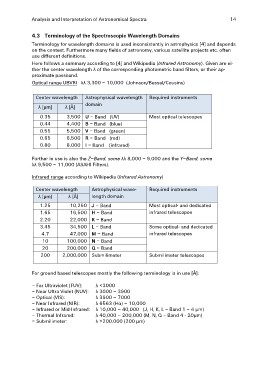
4.3 Terminology of the Spectroscopic Wavelength Domains

Terminology for wavelength domains is used inconsistently in astrophysics [4] and depends
on the context. Furthermore many fields of astronomy, various satellite projects etc. often
use different definitions.
Here follows a summary according to [4] and Wikipedia (Infrared Astronomy). Given are ei-
ther the center wavelength λ of the corresponding photometric band filters, or their ap-
proximate passband.
Optical range UBVRI λλ 3,300 – 10,000 (Johnson/Bessel/Cousins)

Center wavelength  Astrophysical wavelength          Required instruments
                   domain                            Most optical telescopes
λ [μm]  λ [Å]

0.35    3,500      U – Band (UV)
0.44    4,400      B – Band (blue)
0.55    5,500      V – Band (green)
0.65    6,500      R – Band (red)
0.80    8,000      I – Band (infrared)

Further in use is also the Z–Band, some λλ 8,000 – 9,000 and the Y–Band, some
λλ 9,500 – 11,000 (ASAHI Filters).
Infrared range according to Wikipedia (Infrared Astronomy)

Center wavelength            Astrophysical wave-     Required instruments
                             length domain
λ [μm]  λ [Å]                                        Most optical- and dedicated
                                                     infrared telescopes
1.25        10,250           J – Band                Some optical- and dedicated
1.65        16,500           H – Band                infrared telescopes
2.20        22,000           K – Band
3.45        34,500           L – Band                Submilimeter telescopes
4.7         47,000           M – Band
 10       100,000            N – Band
 20       200,000            Q – Band
200     2,000,000            Submilimeter

For ground based telescopes mostly the following terminology is in use [Å]:

– Far Ultraviolet (FUV):     λ <3000
– Near Ultra Violet (NUV):   λ 3000 – 3900
– Optical (VIS):             λ 3900 – 7000
– Near Infrared (NIR):       λ 6563 (Hα) – 10,000
– Infrared or Mid-Infrared:  λ 10,000 – 40,000 (J, H, K, L – Band 1 – 4 μm)
– Thermal Infrared:          λ 40,000 – 200,000 (M, N, Q – Band 4 - 20μm)
– Submilimeter:              λ >200,000 (200 μm)

