


Page 18 - analysis-and-interpretation-of-astronomical-sp
P. 18
Analysis and Interpretation of Astronomical Spectra  18

5.8 Reflectance Spectrum
The objects of our solar system are not self-luminous, but only visible thanks to reflected
sunlight. Therefore, these spectra always contain the absorption lines of the solar spec-
trum. The continuum course is however coined, because certain molecules in the atmos-
pheres of the large gas planets, eg CH4 (methane), absorb and/or reflect the light differ-
ently strong at specific wavelengths.
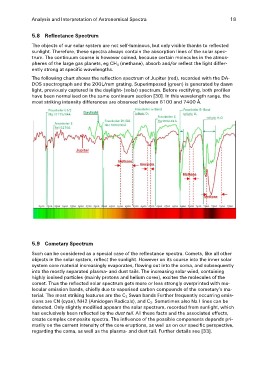
The following chart shows the reflection spectrum of Jupiter (red), recorded with the DA-
DOS spectrograph and the 200L/mm grating. Superimposed (green) is generated by dawn
light, previously captured in the daylight- (solar) spectrum. Before rectifying, both profiles
have been normalised on the same continuum section [30]. In this wavelength range, the
most striking intensity differences are observed between 6100 and 7400 Å.

5.9 Cometary Spectrum

Such can be considered as a special case of the reflectance spectra. Comets, like all other
objects in the solar system, reflect the sunlight. However on its course into the inner solar
system core material increasingly evaporates, flowing out into the coma, and subsequently
into the mostly separated plasma- and dust tails. The increasing solar wind, containing
highly ionised particles (mainly protons and helium cores), excites the molecules of the
comet. Thus the reflected solar spectrum gets more or less strongly overprinted with mo-
lecular emission bands, chiefly due to vaporised carbon compounds of the cometary’s ma-
terial. The most striking features are the C2 Swan bands Further frequently occurring emis-
sions are CN (cyan), NH2 (Amidogen Radicals), and C3. Sometimes also Na I lines can be
detected. Only slightly modified appears the solar spectrum, recorded from sunlight, which
has exclusively been reflected by the dust tail. All these facts and the associated effects,
create complex composite spectra. The influence of the possible components depends pri-
marily on the current intensity of the core eruptions, as well as on our specific perspective,
regarding the coma, as well as the plasma- and dust tail. Further details see [33].

