


Page 122 - spectroscopic-atlas-5_0-english_Neat
P. 122
Spectroscopic Atlas for Amateur Astronomers                                         122

26.5 Absorption Line Galaxies

The principle of the absorption line galaxy is demonstrated here by the example of the An-
dromeda galaxy M31. In this type, star-like spectra appear almost with exclusively absorp-
tion lines.

Table 70: Absorption line Galaxy Andromeda M31/NGC224

The table shows heliocentric parameters according to NED [501], and Evans, N.W. Wilkin-
son (2000) [1] (Value including suspected dark matter).

Radial    Redshift z Distance  Morphology Diameter           Mass 1
Velocity

–300km/s –0.001 2.6 M ly       Sb 141,000 ly 1.23 1012 M

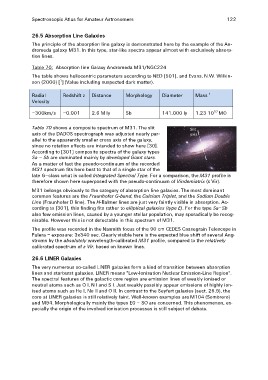
Table 70 shows a composite spectrum of M31. The slit         Slit
axis of the DADOS spectrograph was adjusted nearly par-      axis

allel to the apparently smaller cross axis of the galaxy,

since no rotation effects are intended to show here [30].

According to [301] composite spectra of the galaxy types

Sa – Sb are dominated mainly by developed Giant stars.

As a matter of fact the pseudo-continuum of the recorded

M31 spectrum fits here best to that of a single star of the

late G–class what is called Integrated Spectral Type. For a comparison, the M31 profile is

therefore shown here superposed with the pseudo-continuum of Vindemiatrix (ε Vir).

M31 belongs obviously to the category of absorption line galaxies. The most dominant
common features are the Fraunhofer G-band, the Calcium Triplet, and the Sodium Double
Line (Fraunhofer D line). The H-Balmer lines are just very faintly visible in absorption. Ac-
cording to [301], this finding fits rather to elliptical galaxies (type E). For the type Sa–Sb

also few emission lines, caused by a younger stellar population, may sporadically be recog-
nisable. However this is not detectable in this spectrum of M31.

The profile was recorded in the Nasmith focus of the 90 cm CEDES Cassegrain Telescope in
Falera – exposure: 3x340 sec. Clearly visible here is the expected blue shift of several Ang-
stroms by the absolutely wavelength-calibrated M31 profile, compared to the relatively
calibrated spectrum of ε Vir, based on known lines.

26.6 LINER Galaxies

The very numerous so-called LINER galaxies form a kind of transition between absorption
lines and starburst galaxies. LINER means "Low-Ionisation Nuclear Emission-Line Region".
The spectral features of the galactic core region are emission lines of weakly ionised or
neutral atoms such as O I, N I and S I. Just weakly possibly appear emissions of highly ion-
ised atoms such as He I, Ne II and O II. In contrast to the Seyfert galaxies (sect. 26.9), the
core at LINER galaxies is still relatively faint. Well-known examples are M104 (Sombrero)
and M94. Morphologically mainly the types E0 – SO are concerned. This phenomenon, es-
pecially the origin of the involved ionisation processes is still subject of debate.

