


Page 20 - DINOSOUR ATLAS
P. 20
Dinosaur atlas
         Fossil Record


         EvErything that wE know about dinosaurs has been worked out from
         their fossils. Most fossils are of tough teeth and bones, which have
         been buried and gradually turned to stone by minerals replacing
         the once-living tissue. This usually happens under water, so fossils
         of sea creatures are much more common than fossils of land animals
         like dinosaurs. Many dinosaur species have left only fragmentary
         fossils, such as a few teeth or the odd leg bone. It is also very rare
         for soft tissues like skin to be fossilized. So the “fossil record” is
         incomplete, and many details of dinosaur anatomy are unknown.


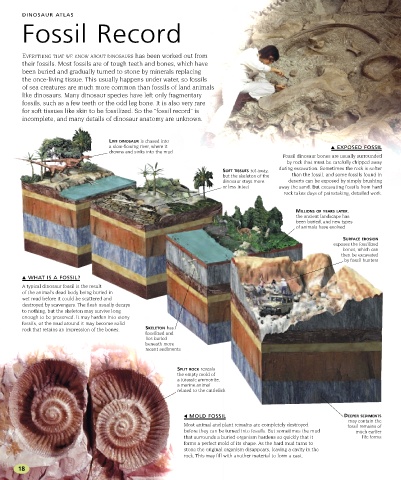
                                        Live dinosaur is chased into
                                        a slow-flowing river, where it                                                 u exposeD fossil
                                        drowns and sinks into the mud
                                                                                                      Fossil dinosaur bones are usually surrounded
                                                                                                       by rock that must be carefully chipped away
                                                                                                    during excavation. Sometimes the rock is softer
                                                                                soft tissues rot away,
                                                                                but the skeleton of the   than the fossil, and some fossils found in
                                                                                dinosaur stays more     deserts can be exposed by simply brushing
                                                                                or less intact      away the sand. But excavating fossils from hard
                                                                                                      rock takes days of painstaking, detailed work.


                                                                                                          MiLLions of years Later,
                                                                                                          the ancient landscape has
                                                                                                          been buried, and new types
                                                                                                          of animals have evolved
                                                                                                                           surface erosion
                                                                                                                        exposes the fossilized
                                                                                                                           bones, which can
                                                                                                                           then be excavated
                                                                                                                            by fossil hunters


         u what is a fossil?
         A typical dinosaur fossil is the result
         of the animal’s dead body being buried in
         wet mud before it could be scattered and
         destroyed by scavengers. The flesh usually decays
         to nothing, but the skeleton may survive long
         enough to be preserved. It may harden into stony
         fossils, or the mud around it may become solid
         rock that retains an impression of the bones.   skeLeton has
                                                     fossilized and
                                                     lies buried
                                                     beneath more
                                                     recent sediments


                                                                spLit rock reveals
                                                                the empty mold of
                                                                a Jurassic ammonite,
                                                                a marine animal
                                                                related to the cuttlefish


                                                                   , MolD fossil                                            deeper sediMents
                                                                                                                             may contain the
                                                                   Most animal and plant remains are completely destroyed    fossil remains of
                                                                   before they can be turned into fossils. But sometimes the mud   much earlier
                                                                   that surrounds a buried organism hardens so quickly that it    life forms
                                                                   forms a perfect mold of its shape. As the hard mud turns to
                                                                   stone the original organism disappears, leaving a cavity in the
                                                                   rock. This may fill with another material to form a cast.
       18

