


Page 43 - DINOSOUR ATLAS
P. 43
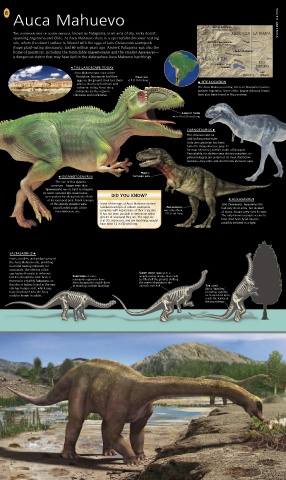
Auca Mahuevo
    42


                                                                                                                                Sierra Chachahuén                     south america
                                                                                                                                6,775 ft (2,065 m)
         The souThern parT of souTh america, known as Patagonia, is an area of dry, rocky desert,                                          MENDOZA      LA PAMPA
         spanning Argentina and Chile. At Auca Mahuevo there is a spectacular dinosaur nesting
         site, where the desert surface is littered with the eggs of Late Cretaceous sauropods                               Sierra de Auca Mahuida  Colorado
                                                                                                                                7,220 ft (2,200 m)
         (huge plant-eating dinosaurs), laid 80 million years ago. Ancient Patagonia was also the
                                                                                                                                             Auca Mahuevo
         home of predators, including the formidable Giganotosaurus and the smaller Aucasaurus—                                        Cuenca del Añelo
         a dangerous visitor that may have fed on the defenseless Auca Mahuevo hatchlings.
                                                                                                                         N E U Q U É N
                                                                                                                                                           RIO
                                                                                                                                             Neuquén
                                                                                                                                 Embalse Cerros
                                           , the landscape todaY                                                                     Colorados            NEGRO
                                             Auca Mahuevo was once a river                                                                                  Lago
                                              floodplain. Sauropods laid their    head was                                                        Neuquén   Pellegrini
                                               eggs on the ground, then lost them   6 ft (1.8 m) long                  u site location
                                               when a flood covered them with
                                               sediment. Today, these deep                                             The Auca Mahuevo nesting site is in Neuquén Province,
                                              sediments are the region’s                                               western Argentina. Some of the largest dinosaur fossils
                                             siltstones and mudstones.                                                 have also been found in this province.


                                                                                                                 largeSt teeth
                                                                                                        were 8 in (20 cm) long


                                                                                                                 carnotaurus .
                                                                                                                 This dinosaur was an
                                                                                                                 odd-looking meat-eater.
                                                                                                                 Only one specimen has been
                                                                                                                 found in Patagonia (see page 37
                                                                                                                 for map reference), farther south of Neuquén.
                                                                                                                 Remarkably, its skeleton was almost complete, so
                                                                                                                 paleontologists are certain of its most distinctive
                                                                                                                 features—tiny arms and short horns above its eyes.


                                                                                        Pebbly-
                                    , GiGanotosaurus                            textured Skin
                                  The size of this gigantic
                               carnivore—bigger even than
                            Tyrannosaurus rex—is hard to imagine.
                           Its teeth, serrated like steak knives,
                            were perfect for slicing into the flesh   did you know?
                             of its sauropod prey. Fossil remains                                                                        , aucasaurus
                               of this deadly predator were   . Some of the eggs at Auca Mahuevo contain                             Like Carnotaurus, Aucasaurus also
                                 found farther south of the    fossilized embryos of unborn sauropods,   aucaSauruS                  had very short arms, but instead
                                  Auca Mahuevo site.         complete with impressions of their scaly skin.   was only about         of horns, bumps grew over its eyes.
                                                             It has not been possible to determine which   3 ft (1 m) long           The only known example seems to
                                                             species of sauropod they are. The eggs are
                                                             6 in (15 cm) across, and the hatchlings would                           have died from head injuries,
                                                             have been 12 in (30 cm) long.                                           possibly inflicted in a fight.


       saltasaurus .
       Ferns, conifers, and ginkgos grew at
       the Auca Mahuevo site, providing
       food and nesting materials for
       sauropods. The identity of the
       egg-laying dinosaur is unknown,                                              Short front legS were a
       but it is thought to have been a     SkeletonS of some                       weight-saving design that could
       titanosaur, possibly Saltasaurus, as   sauropods appear to have              be lifted off the ground, shifting
                                                                                    the center of gravity to the
                                            been designed to enable them
       the skin of babies found at the nest   to stand up on their hind legs        animal’s rear half                      tail acted
       site has bumps on it, which may                                                                                      like a “third leg,”
       have developed into the bony                                                                                         providing stability
       nodules known in adults.                                                                                             as it stretched up to
                                                                                                                            reach the leaves at
                                                                                                                            the top of trees

