


Page 46 - DINOSOUR ATLAS
P. 46
EuropE
         Europe’s First Dinosaurs


         The firsT dinosaurs to wander across Europe appeared in the Late Triassic,
         about 225 million years ago. At this time, Europe was at the northern edge
         of the Pangaea supercontinent, lying close to the equator. The temperature                     +).'$/-
                                                                                                         5.)4%$
         was high and the environment dry. In the north coastal zone conditions                            "RISTOL  '%2-!.9
         were more suitable for plants and animals, and it was here that Plateosaurus                                  (ALLE
                                                                                                                     3TUTTGART
         and other herbivores lived, feeding on the region’s ginkgoes and                     " 5 - " / 5 * $   0 $ & " /  3TRASBOURG  :URICH
         other vegetation. There were also early meat-eaters, such as                                      &2!.#%    37)4:%2,!.$
         Liliensternus. These primitive dinosaurs were ancestors of the                                              )
         more advanced species that came after them in later periods.                                                 4 ! , 9


                                           , GINKGo                                                            . F E J U F S S B O F B O   4 F B
                                               The ginkgo, which is also                    u SITE LoCATIoN
                                                known as the maidenhair tree,
                                                 is a “living fossil” that can be           More than 50 European locations have produced
                                                  seen growing today. Its                   Late Triassic dinosaur fossils. Many of these sites
                                                  ancestors first appeared                  are concentrated in Germany and France, where
                                                  some 270 million years                    ancient rocks once formed the northern edge of
                                                 ago, and fossils of their                  the Pangaea supercontinent.
                                                 fan-shaped leaves are found
                                               in many parts of the world.


            pLATEoSAuruS SKELEToN
            The real-life positions of Plateosaurus bones
            can be reconstructed with accuracy because
            several articulated skeletons have been
            found. In this reconstruction, at a museum
            in Germany, an adult Plateosaurus is
            shown rearing up from all fours
            as if to reach high into a tree
            to feed on some leaves.

            taiL was about
            half the length of
            the dinosaur
                                                                                u pLATEoSAuruS
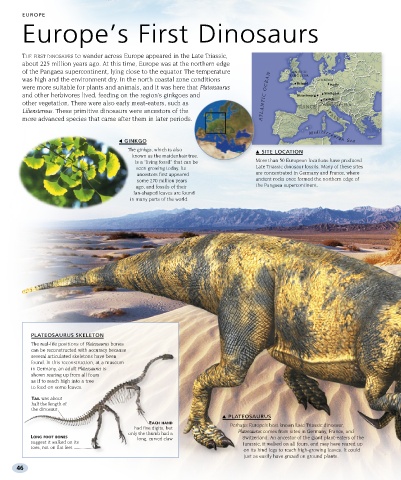
                                                      each hand                    Perhaps Europe’s best known Late Triassic dinosaur,
                                                 had five digits, but
                                               only the thumb had a                   Plateosaurus comes from sites in Germany, France, and
            Long foot bones                       long, curved claw                    Switzerland. An ancestor of the giant plant-eaters of the
            suggest it walked on its                                                    Jurassic, it walked on all fours, and may have reared up
            toes, not on flat feet
                                                                                        on its hind legs to reach high-growing leaves. It could
                                                                                        just as easily have grazed on ground plants.
       46

