


Page 140 - Euclid's Elements of Geometry
P. 140
ST	EW      eþ.


                                                                                            ELEMENTS BOOK 5


            πολλαπλασιάσθω, καὶ ἔστω τὸ ΗΘ πολλαπλάσιον μὲν τοῦ ratio to C than D (has) to AB [Def. 5.5].
            ΕΒ, μεῖζον δὲ τοῦ Δ· καὶ ὁσαπλάσιόν ἐστι τὸ ΗΘ τοῦ ΕΒ,  And so let AE be greater than EB. So, the lesser,
            τοσαυταπλάσιον γεγονέτω καὶ τὸ μὲν ΖΗ τοῦ ΑΕ, τὸ δὲ Κ  EB, being multiplied, will sometimes be greater than D.
            τοῦ Γ. ὁμοίως δὴ δείξομεν, ὅτι τὰ ΖΘ, Κ τῶν ΑΒ, Γ ἰσάκις Let it have been multiplied, and let GH be a multiple of
            ἐστὶ πολλαπλάσια· καὶ εἰλήφθω ὁμοίως τὸ Ν πολλαπλάσιον EB (which is) greater than D. And as many times as
            μὲν τοῦ Δ, πρώτως δὲ μεῖζον τοῦ ΖΗ· ὥστε πάλιν τὸ ΖΗ GH is (divisible) by EB, so many times let FG also have
            τοῦ Μ οὔκ ἐστιν ἔλασσον. μεῖζον δὲ τὸ ΗΘ τοῦ Δ· ὅλον become (divisible) by AE, and K by C. So, similarly
            ἄρα τὸ ΖΘ τῶν Δ, Μ, τουτέστι τοῦ Ν, ὑπερέχει. τὸ δὲ Κ  (to the above), we can show that FH and K are equal
            τοῦ Ν οὐχ ὑπερέχει, ἐπειδήπερ καὶ τὸ ΖΗ μεῖζον ὂν τοῦ multiples of AB and C (respectively). And, similarly (to
            ΗΘ, τουτέστι τοῦ Κ, τοῦ Ν οὐχ ὑπερέχει. καὶ ὡσαύτως  the above), let the multiple N of D, (which is) the first
            κατακολουθοῦντες τοῖς ἐπάνω περαίνομεν τὴν ἀπόδειξιν.  (multiple) greater than FG, have been taken. So, FG
               Τῶν ἄρα ἀνίσων μεγεθῶν τὸ μεῖζον πρὸς τὸ αὐτὸ is again not less than M. And GH (is) greater than D.
            μείζονα λόγον ἔχει ἤπερ τὸ ἔλαττον· καὶ τὸ αὐτὸ πρὸς τὸ  Thus, the whole of FH exceeds D and M, that is to say
            ἔλαττον μείζονα λόγον ἔχει ἤπερ πρὸς τὸ μεῖζον· ὅπερ ἔδει N. And K does not exceed N, inasmuch as FG, which
                                    jþ                          tude) has a greater ratio than the lesser to the same (mag-
            δεῖξαι.                                             (is) greater than GH—that is to say, K—also does not
                                                                exceed N. And, following the above (arguments), we
                                                                (can) complete the proof in the same manner.
                                                                   Thus, for unequal magnitudes, the greater (magni-

                                                                nitude). And the latter (magnitude) has a greater ratio to
                                                                the lesser (magnitude) than to the greater. (Which is) the
                                                                very thing it was required to show.

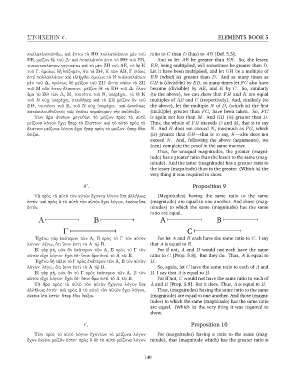
                                                                                  Proposition 9
                                      .
               Τὰ πρὸς τὸ αὐτὸ τὸν αὐτὸν ἔχοντα λὸγον ἴσα ἀλλήλοις  (Magnitudes) having the same ratio to the same
            ἐστίν· καὶ πρὸς ἃ τὸ αὐτὸ τὸν αὐτὸν ἕχει λόγον, ἐκεῖνα ἴσα (magnitude) are equal to one another. And those (mag-
            ἐστίν.                                              nitudes) to which the same (magnitude) has the same
                                                                ratio are equal.
                 Α                      Β                           A                       B

                           Γ                                                   C

               ᾿Εχέτω γὰρ ἑκάτερον τῶν Α, Β πρὸς τὸ Γ τὸν αὐτὸν    For let A and B each have the same ratio to C. I say
            λόγον· λέγω, ὅτι ἴσον ἐστὶ τὸ Α τῷ Β.               that A is equal to B.
               Εἰ γὰρ μή, οὐκ ἂν ἑκάτερον τῶν Α, Β πρὸς τὸ Γ τὸν   For if not, A and B would not each have the same
            αὐτὸν εἶχε λόγον· ἔχει δέ· ἴσον ἄρα ἐστὶ τὸ Α τῷ Β.  ratio to C [Prop. 5.8]. But they do. Thus, A is equal to
               ᾿Εχέτω δὴ πάλιν τὸ Γ πρὸς ἑκάτερον τῶν Α, Β τὸν αὐτὸν B.
            λόγον· λέγω, ὅτι ἴσον ἐστὶ τὸ Α τῷ Β.                  So, again, let C have the same ratio to each of A and
                                    iþ                          tudes) to which the same (magnitude) has the same ratio
               Εἰ γὰρ μή, οὐκ ἂν τὸ Γ πρὸς ἑκάτερον τῶν Α, Β τὸν B. I say that A is equal to B.
            αὐτὸν εἶχε λόγον· ἔχει δέ· ἴσον ἄρα ἐστὶ τὸ Α τῷ Β.    For if not, C would not have the same ratio to each of
               Τὰ ἄρα πρὸς τὸ αὐτὸ τὸν αὐτὸν ἔχοντα λόγον ἴσα A and B [Prop. 5.8]. But it does. Thus, A is equal to B.
            ἀλλήλοις ἐστίν· καὶ πρὸς ἃ τὸ αὐτὸ τὸν αὐτὸν ἔχει λόγον,  Thus, (magnitudes) having the same ratio to the same
            ἐκεῖνα ἴσα ἐστίν· ὅπερ ἔδει δεῖξαι.                 (magnitude) are equal to one another. And those (magni-


                                                                are equal. (Which is) the very thing it was required to
                                                                show.

                                                                                 Proposition 10
                                     .
               Τῶν πρὸς τὸ αὐτὸ λόγον ἐχόντων τὸ μείζονα λόγον     For (magnitudes) having a ratio to the same (mag-
            ἔχον ἐκεῖνο μεῖζόν ἐστιν· πρὸς ὃ δὲ τὸ αὐτὸ μείζονα λόγον nitude), that (magnitude which) has the greater ratio is


                                                             140

