


Page 36 - X-Air User's Manual
P. 36
36  X AIR User Manual


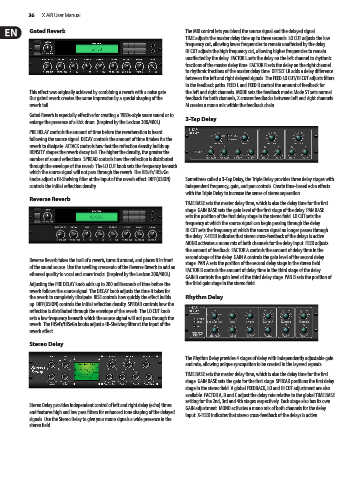
           Gated Reverb                                        The MIX control lets you blend the source signal and the delayed signal.
                                                               TIME adjusts the master delay time up to three seconds. LO CUT adjusts the low
                                                               frequency cut, allowing lower frequencies to remain unaffected by the delay.
                                                               HI CUT adjusts the high frequency cut, allowing higher frequencies to remain
                                                               unaffected by the delay. FACTOR L sets the delay on the left channel to rhythmic
                                                               fractions of the master delay time. FACTOR R sets the delay on the right channel
                                                               to rhythmic fractions of the master delay time. OFFSET LR adds a delay difference
                                                               between the left and right delayed signals. The FEED LO CUT/HI CUT adjusts filters
                                                               in the feedback paths. FEED L and FEED R control the amount of feedback for
           This effect was originally achieved by combining a reverb with a noise gate.   the left and right channels. MODE sets the feedback mode: Mode ST sets normal
           Our gated reverb creates the same impression by a special shaping of the   feedback for both channels, X crosses feedbacks between left and right channels.
           reverb tail.                                        M creates a mono mix within the feedback chain.

           Gated Reverb is especially effective for creating a 1980s-style snare sound or to
           enlarge the presence of a kick drum. (Inspired by the Lexicon 300/480L)  3-Tap Delay
           PRE DELAY controls the amount of time before the reverberation is heard
           following the source signal. DECAY controls the amount of time it takes for the
           reverb to dissipate. ATTACK controls how fast the reflection density builds up.
           DENSITY shapes the reverb decay tail. The higher the density, the greater the
           number of sound reflections. SPREAD controls how the reflection is distributed
           through the envelope of the reverb. The LO CUT knob sets the frequency beneath
           which the source signal will not pass through the reverb. The HiSvFr/ HiSvGn
           knobs adjust a Hi-Shelving filter at the input of the reverb effect. DIFF(USION)   Sometimes called a 3-Tap Delay, the Triple Delay provides three delay stages with
           controls the initial reflection density.            independent frequency, gain, and pan controls. Create time-based echo effects
                                                               with the Triple Delay to increase the sense of stereo separation.
           Reverse Reverb
                                                               TIME BASE sets the master delay time, which is also the delay time for the first
                                                               stage. GAIN BASE sets the gain level of the first stage of the delay. PAN BASE
                                                               sets the position of the first delay stage in the stereo field. LO CUT sets the
                                                               frequency at which the source signal can begin passing through the delay.
                                                               HI CUT sets the frequency at which the source signal no longer passes through
                                                               the delay. X-FEED indicates that stereo cross-feedback of the delays is active.
                                                               MONO activates a mono mix of both channels for the delay input. FEED adjusts
                                                               the amount of feedback. FACTOR A controls the amount of delay time in the
                                                               second stage of the delay. GAIN A controls the gain level of the second delay
           Reverse Reverb takes the trail of a reverb, turns it around, and places it in front
           of the sound source. Use the swelling crescendo of the Reverse Reverb to add an   stage. PAN A sets the position of the second delay stage in the stereo field.
                                                               FACTOR B controls the amount of delay time in the third stage of the delay.
           ethereal quality to vocal and snare tracks. (Inspired by the Lexicon 300/480L)
                                                               GAIN B controls the gain level of the third delay stage. PAN B sets the position of
           Adjusting the PRE DELAY knob adds up to 200 milliseconds of time before the   the third gain stage in the stereo field.
           reverb follows the source signal. The DECAY knob adjusts the time it takes for
           the reverb to completely dissipate. RISE controls how quickly the effect builds   Rhythm Delay
           up. DIFF(USION) controls the initial reflection density. SPREAD controls how the
           reflection is distributed through the envelope of the reverb. The LO CUT knob
           sets a low frequency beneath which the source signal will not pass through the
           reverb. The HiSvFr/HiSvGn knobs adjust a Hi-Shelving filter at the input of the
           reverb effect.

           Stereo Delay
                                                               The Rhythm Delay provides 4 stages of delay with independently adjustable gain
                                                               and rate, allowing unique syncopation to be created in the layered repeats.
                                                               TIME BASE sets the master delay time, which is also the delay time for the first
                                                               stage. GAIN BASE sets the gain for the first stage. SPREAD positions the first delay
                                                               stage in the stereo field. A global FEEDBACK, LO and HI CUT adjustment are also
                                                               available. FACTOR A, B and C adjust the delay rate relative to the global TIME BASE
                                                               setting for the 2nd, 3rd and 4th stages respectively. Each stage also has its own
           Stereo Delay provides independent control of left and right delay (echo) times   GAIN adjustment. MONO activates a mono mix of both channels for the delay
           and features high and low pass filters for enhanced tone shaping of the delayed
           signals. Use the Stereo Delay to give your mono signals a wide presence in the   input. X-FEED indicates that stereo cross-feedback of the delays is active.
           stereo field.

