


Page 29 - (DK Eyewitness) Travel Guide - Australia
P. 29
A POR TR AIT OF A USTR ALIA 27
The Australian Continent
The Australian continent finally broke away
from its last adjoining landmass, Antarctica,
40 million years ago and embarked on a long
period of geographical isolation. During this
time Australia’s unique flora and fauna evolved
and flourished (see pp28–9). Aboriginal people
lived undisturbed on this continent for at least
40,000 years, developing the land to their own
needs, until the arrival of Europeans in 1770
(see pp50–55).
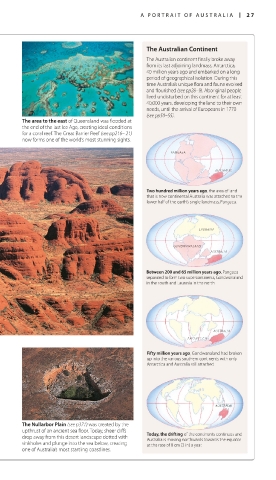
The area to the east of Queensland was flooded at
the end of the last Ice Age, creating ideal conditions
for a coral reef. The Great Barrier Reef (see pp216– 21)
now forms one of the world’s most stunning sights.
PANGAEA
AUSTRALIA
Two hundred million years ago, the area of land
that is now continental Australia was attached to the
lower half of the earth’s single landmass, Pangaea.
LAURASIA
GONDWANALAND
AUSTRALIA
Between 200 and 65 million years ago, Pangaea
separated to form two supercontinents, Gondwanaland
in the south and Laurasia in the north.
AUSTRALIA
ANTARCTICA
Fifty million years ago, Gondwanaland had broken
up into the various southern continents with only
Antarctica and Australia still attached.
AUSTRALIA
The Nullarbor Plain (see p371) was created by the
upthrust of an ancient sea floor. Today, sheer cliffs Today, the drifting of the continents continues and
drop away from this desert landscape dotted with Australia is moving northwards towards the equator
sinkholes and plunge into the sea below, creating at the rate of 8 cm (3 in) a year.
one of Australia’s most startling coastlines.

