


Page 32 - (DK Eyewitness) Travel Guide - Australia
P. 32
30 INTRODUCING A USTR ALIA
World Heritage Areas of Australia
UNESCO’s World Heritage Convention was adopted in 1972
to protect areas of universal cultural and natural significance.
Nineteen groups of sites in Australia are inscribed on the
World Heritage List and include unusual landforms, ancient
forests and areas of staggering biodiversity, as well as 12
historic convict sites and the Sydney Opera House. Several of
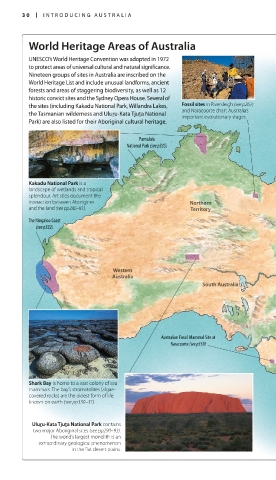
the sites (including Kakadu National Park, Willandra Lakes, Fossil sites in Riversleigh (see p261)
the Tasmanian wilderness and Uluru-Kata Tjuta National and Naracoorte chart Australia’s
important evolutionary stages.
Park) are also listed for their Aboriginal cultural heritage.
Purnululu
National Park (see p335)
K K Kakadu National Park is a akadu National Park is a akadu National Park
landscape of wetlands and tropical
splendour. Art sites document the
interaction between Aborigines Northern
and the land (see pp280–81). Territory
The Ningaloo Coast
(see p332)
Western
Australia
South Australia
Australian Fossil Mammal Site at
Naracoorte (see p359)
Shark Bay is home to a vast colony of sea
mammals. The bay’s stromatolites (algae-
covered rocks) are the oldest form of life
known on earth (see pp330–31).
Uluru-Kata Tjuta National Park contains a National Park contains a National Park
two major Aboriginal sites (see pp290–93).
The world’s largest monolith is an
extraordinary geological phenomenon
in the flat desert plains.

