


Page 31 - (DK Eyewitness) Travel Guide - Australia
P. 31
A POR TR AIT OF A USTR ALIA 29
Mammals
Australian mammals are distinctive because the population
is dominated by two groups that are rare or non-existent
elsewhere. Monotremes, such as the
platypus, are found only in Australia and
New Guinea, and marsupials, represented by
180 species here, are scarce in other parts of
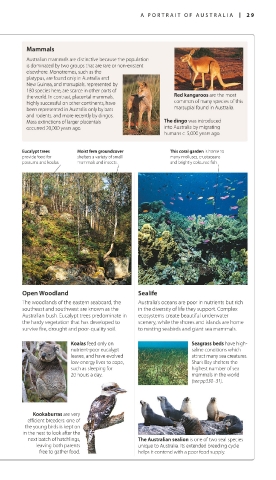
the world. In contrast, placental mammals, Red kangaroos are the most
highly successful on other continents, have common of many species of this
been represented in Australia only by bats marsupial found in Australia.
and rodents, and more recently by dingos.
Mass extinctions of larger placentals The dingo was introduced
occurred 20,000 years ago. into Australia by migrating
humans c. 5,000 years ago.
Eucalypt trees Moist fern groundcover This coral garden is home to
provide food for shelters a variety of small many molluscs, crustaceans
possums and koalas. mammals and insects. and brightly coloured fish.
Open Woodland Sealife
The woodlands of the eastern seaboard, the Australia’s oceans are poor in nutrients but rich
southeast and southwest are known as the in the diversity of life they support. Complex
Australian bush. Eucalypt trees predominate in ecosystems create beautiful underwater
the hardy vegetation that has developed to scenery, while the shores and islands are home
survive fire, drought and poor-quality soil. to nesting seabirds and giant sea mammals.
Koalas feed only on Seagrass beds have high-
nutrient-poor eucalypt saline conditions which
leaves, and have evolved attract many sea creatures.
low-energy lives to cope, Shark Bay shelters the
such as sleeping for highest number of sea
20 hours a day. mammals in the world
(see pp330–31).
Kookaburras are very
efficient breeders: one of
the young birds is kept on
in the nest to look after the
next batch of hatchlings, The Australian sealion is one of two seal species
leaving both parents unique to Australia. Its extended breeding cycle
free to gather food. helps it contend with a poor food supply.

