


Page 33 - (DK Eyewitness) Travel Guide - Australia
P. 33
A POR TR AIT OF A USTR ALIA 31
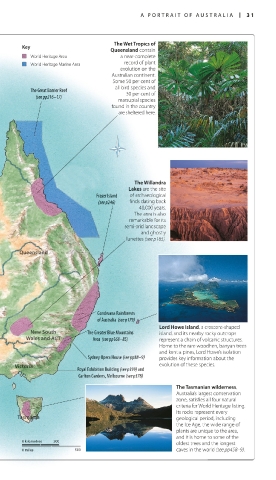
The Wet Tropics of
Key
Queensland contain
World Heritage Area a near-complete
World Heritage Marine Area record of plant
evolution on the
Australian continent.
Some 50 per cent of
all bird species and
The Great Barrier Reef 30 per cent of
(see pp216–17)
marsupial species
found in the country
are sheltered here.
The Willandra
Lakes are the site
Fraser Island of archaeological
(see p246) finds dating back
40,000 years.
The area is also
remarkable for its
semi-arid landscape
and ghostly
lunettes (see p185).
Queensland
Gondwana Rainforests
of Australia (see p179)
Lord Howe Island, a crescent-shaped
New South The Greater Blue Mountains island, and its nearby rocky outcrops
Wales and ACT Area (see pp168–85) represent a chain of volcanic structures.
Home to the rare woodhen, banyan trees
and kentia pines, Lord Howe’s isolation
Sydney Opera House (see pp88–9) provides key information about the
Victoria Royal Exhibition Building (see p399) and evolution of these species.
Carlton Gardens, Melbourne (see p378)
The Tasmanian wilderness,
Australia’s largest conservation
zone, satisfies all four natural
criteria for World Heritage listing.
Its rocks represent every
Tasmania geological period, including
the Ice Age, the wide range of
plants are unique to the area,
and it is home to some of the
0 kilometres 500 oldest trees and the longest
0 miles 500 caves in the world (see pp458–9).

