


Page 19 - Encyclopedia of Aquarium and Pond Fish, 3rd Edition
P. 19
WHAT IS A FISH?    17


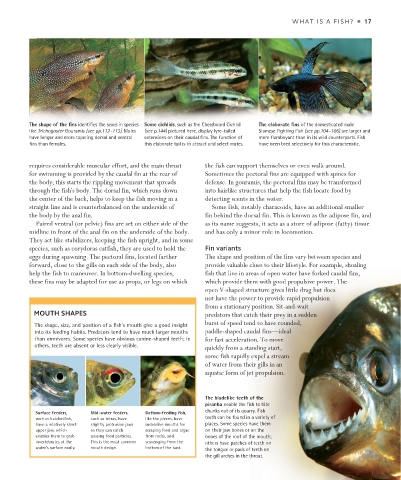
         The shape of the fins identifies the sexes in species  Some cichlids, such as the Chessboard Cichlid    The elaborate fins of the domesticated male
         like Trichogaster Gouramis (see pp.112–113). Males   (see p.144) pictured here, display lyre-tailed   Siamese Fighting Fish (see pp.104–106) are larger and
         have longer and more tapering dorsal and ventral   extensions on their caudal fins. The function of    more flamboyant than in its wild counterparts. Fish
         fins than females.              this elaborate tail is to attract and select mates.  have been bred selectively for this characteristic.


         requires considerable muscular effort, and the main thrust    the fish can support themselves or even walk around.
         for swimming is provided by the caudal fin at the rear of    Sometimes the pectoral fins are equipped with spines for
         the body; this starts the rippling movement that spreads   defense. In gouramis, the pectoral fins may be transformed
         through the fish’s body. The dorsal fin, which runs down    into hairlike structures that help the fish locate food by
         the center of the back, helps to keep the fish moving in a   detecting scents in the water.
         straight line and is counterbalanced on the underside of    Some fish, notably characoids, have an additional smaller
         the body by the anal fin.                        fin behind the dorsal fin. This is known as the adipose fin, and
           Paired ventral (or pelvic) fins are set on either side of the   as its name suggests, it acts as a store of adipose (fatty) tissue
         midline in front of the anal fin on the underside of the body.   and has only a minor role in locomotion.
         They act like stabilizers, keeping the fish upright, and in some
         species, such as corydoras catfish, they are used to hold the   Fin variants
         eggs during spawning. The pectoral fins, located farther   The shape and position of the fins vary between species and
         forward, close to the gills on each side of the body, also    provide valuable clues to their lifestyle. For example, shoaling
         help the fish to maneuver. In bottom-dwelling species,    fish that live in areas of open water have forked caudal fins,
         these fins may be adapted for use as props, or legs on which   which provide them with good propulsive power. The
                                                          open V-shaped structure gives little drag but does
                                                          not have the power to provide rapid propulsion
                                                          from a stationary position. Sit-and-wait
          MOUTH SHAPES                                    predators that catch their prey in a sudden
           The shape, size, and position of a fish’s mouth give a good insight   burst of speed tend to have rounded,
           into its feeding habits. Predators tend to have much larger mouths   paddle-shaped caudal fins—ideal
           than omnivores. Some species have obvious canine-shaped teeth; in   for fast acceleration. To move
           others, teeth are absent or less clearly visible.  quickly from a standing start,
                                                          some fish rapidly expel a stream
                                                          of water from their gills in an
                                                          aquatic form of jet propulsion.


                                                          The bladelike teeth of the
                                                          piranha enable the fish to bite
           Surface feeders,    Mid-water feeders,   Bottom-feeding fish,   chunks out of its quarry. Fish
           such as hatchetfish,   such as tetras, have   like the plecos, have   teeth can be found in a variety of
           have a relatively short   slightly protrusive jaws   suckerlike mouths for   places. Some species have them
           upper jaw, which   so they can catch   scraping food and algae   on their jaw bones or on the
           enables them to grab   passing food particles.   from rocks, and   bones of the roof of the mouth;
           invertebrates at the   This is the most common   scavenging from the   others have patches of teeth on
           water’s surface easily.  mouth design.  bottom of the tank.  the tongue or pads of teeth on
                                                          the gill arches in the throat.


   US_016-019_What_is_fish_v2.indd   17                                                              29/08/18   4:08 PM

