


Page 164 - Encyclopedia of Aquarium and Pond Fish, 3rd Edition
P. 164
162    FRESHWATER FISH DIRECTORY


          Xiphophorus maculatus
         Platy                           The Platy is suitable for both a community
                                         aquarium and a single-species setup. A tank for
           ORIGINS  Central America, occurring in Veracruz state in   these fish should incorporate a clear area at the
           Mexico and southward to Belize and Guatemala.  front for swimming, with some specimen plants,
           SIZE  3 in (7.5 cm).          and denser planting around the back and sides.
           DIET  Prepared foods and small live foods.  It is important to include plants such as Java
           WATER  Temperature 64–77°F (18–25°C); hard   Moss (Vesicularia dubyana) if you hope to breed
           (100–150 mg/l) and alkaline (pH 7.5).  these livebearers successfully. Some of the young
           TEMPERAMENT  Peaceful and social.  fish will survive long enough in this dense
                                         vegetation to grow to a size at which they will no
         The Platy has a broad body and naturally rounded   longer be seen as a meal by other fish in the tank.
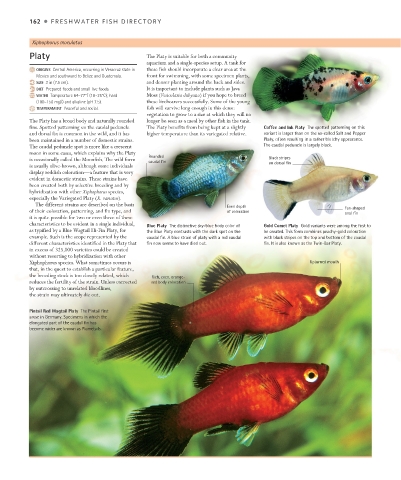
         fins. Spotted patterning on the caudal peduncle   The Platy benefits from being kept at a slightly   Coffee and Ink Platy  The spotted patterning on this
         and dorsal fin is common in the wild, and it has   higher temperature than its variegated relative.  variant is larger than on the so-called Salt and Pepper
         been maintained in a number of domestic strains.                 Platy, often resulting in a rather blotchy appearance.
         The caudal peduncle spot is more like a crescent                 The caudal peduncle is largely black.
         moon in some cases, which explains why the Platy   Rounded
         is occasionally called the Moonfish. The wild form   caudal fin   Black stripes
                                                                           on dorsal fin
         is usually olive-brown, although some individuals
         display reddish coloration—a feature that is very
         evident in domestic strains. These strains have
         been created both by selective breeding and by
         hybridization with other Xiphophorus species,
         especially the Variegated Platy (X. variatus).
           The different strains are described on the basis     Even depth                      Fan-shaped
         of their coloration, patterning, and fin type, and     of coloration                   anal fin
         it is quite possible for two or even three of these
         characteristics to be evident in a single individual,   Blue Platy  The distinctive sky-blue body color of    Gold Comet Platy  Gold variants were among the first to
         as typified by a Blue Wagtail Hi-Fin Platy, for   the Blue Platy contrasts with the dark spot on the   be created. This form combines peachy-gold coloration
         example. Such is the scope represented by the   caudal fin. A blue strain of platy with a red caudal    with black stripes on the top and bottom of the caudal
         different characteristics identified in the Platy that   fin now seems to have died out.  fin. It is also known as the Twin-Bar Platy.
         in excess of 325,000 varieties could be created
         without resorting to hybridization with other
         Xiphophorus species. What sometimes occurs is                                Upturned mouth
         that, in the quest to establish a particular feature,
         the breeding stock is too closely related, which   Rich, even, orange-
         reduces the fertility of the strain. Unless corrected   red body coloration
         by outcrossing to unrelated bloodlines,
         the strain may ultimately die out.

         Pintail Red Wagtail Platy  The Pintail first
         arose in Germany. Specimens in which the
         elongated part of the caudal fin has
         become wider are known as Plumetails.


   US_162-163_Platies.indd   162                                                                     29/08/18   4:09 PM

