


Page 162 - Encyclopedia of Aquarium and Pond Fish, 3rd Edition
P. 162
160    FRESHWATER FISH DIRECTORY


          Xiphophorus hellerii
         Swordtail

           ORIGINS  Central America, ranging down the Atlantic
           side from Mexico to northwestern Honduras.
           SIZE  4 in (10 cm).
           DIET  Prepared foods and small live foods.
           WATER  Temperature 70–77°F (21–25°C); hard
           (100–150 mg/l) and alkaline (pH 7.5).
           TEMPERAMENT  Males are often quarrelsome.
         In common with most domesticated livebearers,                                           Female
         the Swordtail’s color and pattern are very
         different from those of the wild type. Many
         of these fish have a hybrid ancestry, thanks to
         earlier crossings both with other types of
         swordtail and also with platies (see p.162).
         Wild swordtails are usually quite plain-looking
         and greenish, blue, or reddish in coloration,
         while some display blotched patterning. Wild
         populations can vary significantly in
         appearance from place to place.
           In aquarium surroundings,                                                             Male
         mature male swordtails are
         aggressive toward one another. It is
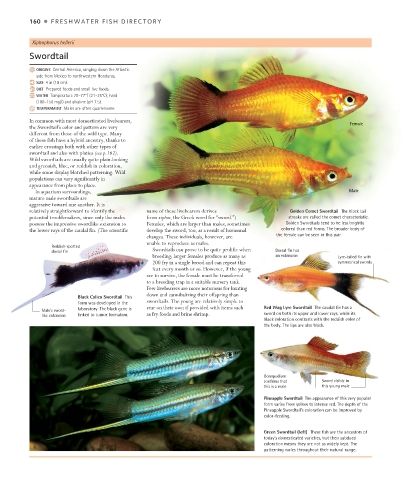
         relatively straightforward to identify the    name of these livebearers derives    Golden Comet Swordtail  The black tail
         potential troublemakers, since only the males   from xiphos, the Greek word for “sword.”)   streaks are called the comet characteristic.
         possess the impressive swordlike extension to    Females, which are larger than males, sometimes   Golden Swordtails tend to be less brightly
         the lower rays of the caudal fin. (The scientific   develop the sword, too, as a result of hormonal   colored than red forms. The broader body of
                                         changes. These individuals, however, are    the female can be seen in this pair.
                                         unable to reproduce as males.
               Reddish-spotted
               dorsal fin                  Swordtails can prove to be quite prolific when   Dorsal fin has
                                           breeding; larger females produce as many as   an extension  Lyre-tailed fin with
                                           200 fry in a single brood and can repeat this      symmetrical swords
                                           feat every month or so. However, if the young
                                         are to survive, the female must be transferred
                                         to a breeding trap in a suitable nursery tank.
                                         Few livebearers are more notorious for hunting
                                         down and cannibalizing their offspring than
                       Black Calico Swordtail  This
                       form was developed in the   swordtails. The young are relatively simple to
             Male’s sword-   laboratory. The black gene is   rear on their own if provided with items such    Red Wag Lyre Swordtail  The caudal fin has a
             like extension  linked to tumor formation.  as fry foods and brine shrimp.  sword on both its upper and lower rays, while its
                                                                          black coloration contrasts with the reddish color of
                                                                          the body. The lips are also black.


                                                                          Gonopodium
                                                                          confirms that   Sword visible in
                                                                          this is a male  this young male
                                                                          Pineapple Swordtail  The appearance of this very popular
                                                                          form varies from yellow to intense red. The depth of the
                                                                          Pineapple Swordtail’s coloration can be improved by
                                                                          color-feeding.

                                                                          Green Swordtail (left)  These fish are the ancestors of
                                                                          today’s domesticated varieties, but their subdued
                                                                          coloration means they are not as widely kept. The
                                                                          patterning varies throughout their natural range.


   US_160-161_Swordtails.indd   160                                                                  29/08/18   4:27 PM

