


Page 160 - Encyclopedia of Aquarium and Pond Fish, 3rd Edition
P. 160
158    FRESHWATER FISH DIRECTORY


          Girardinus metallicus           Dermogenys pusilla              Belonesox belizanus
         Girardinus                      Malayan Halfbeak                 Pike-Top Minnow

           ORIGINS  The Caribbean, where it is widely distributed in   ORIGINS  Southeast Asia, ranging from Thailand and the   ORIGINS  Central America, ranging from southeastern
           Cuba, except in the extreme east.  Malay Peninsula down to parts of Indonesia.  Mexico down to Honduras.
           SIZE  3 ⁄2 in (9 cm).           SIZE  3 in (7.5 cm).             SIZE  8 in (20 cm).
              1
           DIET  Prepared foods, plant matter, and small live foods.  DIET  Mainly small live foods.  DIET  Smaller live foods and fish.
           WATER  Temperature 72–77°F (22–25°C); hard    WATER  Temperature 77–86°F (25–30°C); hard  WATER  Temperature 79–90°F (26–32°C); hard
           (100–150 mg/l) and alkaline (pH 7.1).  (100–150 mg/l) and neutral (pH 7.0).   (200–300 mg/l) and alkaline (pH 7.5).
           TEMPERAMENT  Placid.            TEMPERAMENT  Males are quarrelsome.  TEMPERAMENT  Aggressive.
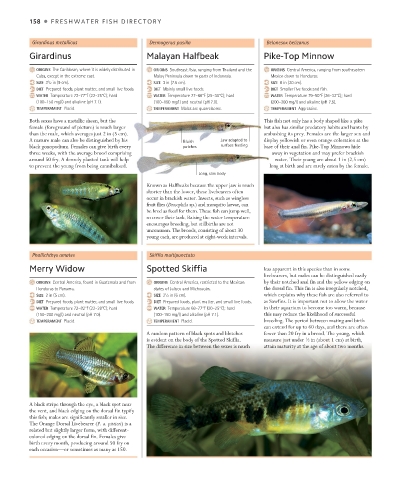
         Both sexes have a metallic sheen, but the                        This fish not only has a body shaped like a pike
         female (foreground of picture) is much larger                    but also has similar predatory habits and hunts by
         than the male, which averages just 2 in (5 cm).                  ambushing its prey. Females are the larger sex and
         A mature male can also be distinguished by his   Bluish   Jaw adapted to   display yellowish or even orange coloration at the
         black gonopodium. Females can give birth every   patches  surface feeding  base of their anal fin. Pike-Top Minnows hide
         three weeks, with the average brood comprising                     away in vegetation and may prefer brackish
         around 50 fry. A densely planted tank will help                     water. Their young are about 1 in (2.5 cm)
         to prevent the young from being cannibalized.                     long at birth and are rarely eaten by the female.
                                                        Long, slim body
                                         Known as Halfbeaks because the upper jaw is much
                                         shorter than the lower, these livebearers often
                                         occur in brackish water. Insects, such as wingless
                                         fruit flies (Drosophila sp.) and mosquito larvae, can
                                         be bred as food for them. These fish can jump well,
                                         so cover their tank. Raising the water temperature
                                         encourages breeding, but stillbirths are not
                                         uncommon. The broods, consisting of about 30
                                         young each, are produced at eight-week intervals.

          Phallichthys amates             Skiffia multipunctata
         Merry Widow                     Spotted Skiffia                  less apparent in this species than in some
                                                                          livebearers, but males can be distinguished easily
           ORIGINS  Central America, found in Guatemala and from   ORIGINS  Central America, restricted to the Mexican   by their notched anal fin and the yellow edging on
           Honduras to Panama.             states of Jalisco and Michoacán.  the dorsal fin. This fin is also irregularly notched,
           SIZE  2 in (5 cm).              SIZE  2 ⁄2 in (6 cm).          which explains why these fish are also referred to
                                               1
           DIET  Prepared foods, plant matter, and small live foods.  DIET  Prepared foods, plant matter, and small live foods.  as Sawfins. It is important not to allow the water
           WATER  Temperature 72–82°F (22–28°C); hard   WATER  Temperature 68–77°F (20–25°C); hard   in their aquarium to become too warm, because
           (150–200 mg/l) and neutral (pH 7.0).  (100–150 mg/l) and alkaline (pH 7.1).   this may reduce the likelihood of successful
           TEMPERAMENT  Placid.            TEMPERAMENT  Placid.           breeding. The period between mating and birth
                                                                          can extend for up to 60 days, and there are often
                                         A random pattern of black spots and blotches    fewer than 20 fry in a brood. The young, which
                                                                                     1
                                         is evident on the body of the Spotted Skiffia.    measure just under  ⁄2 in (about 1 cm) at birth,
                                         The difference in size between the sexes is much   attain maturity at the age of about two months.


         A black stripe through the eye, a black spot near
         the vent, and black edging on the dorsal fin typify
         this fish; males are significantly smaller in size.
         The Orange Dorsal Livebearer (P. a. pittieri) is a
         related but slightly larger form, with different-
         colored edging on the dorsal fin. Females give
         birth every month, producing around 50 fry on
         each occasion—or sometimes as many as 150.


   US_158-159_Live_bearers_Cont_1.indd   158                                                         29/08/18   4:09 PM

