


Page 161 - Encyclopedia of Aquarium and Pond Fish, 3rd Edition
P. 161
LIVEBEARERS    159


                                          Ameca splendens
           BEAK WRESTLING
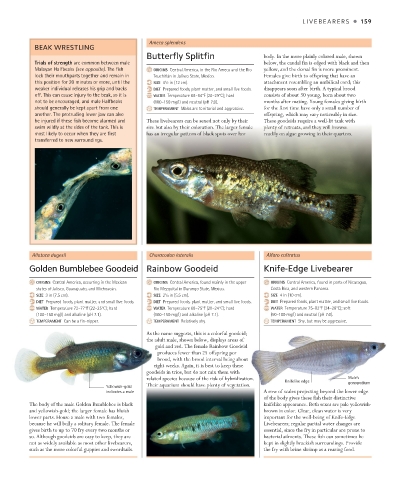
                                         Butterfly Splitfin               body. In the more plainly colored male, shown
           Trials of strength are common between male                     below, the caudal fin is edged with black and then
           Malayan Halfbeaks (see opposite). The fish   ORIGINS  Central America, in the Rio Ameca and the Rio   yellow, and the dorsal fin is more prominent.
           lock their mouthparts together and remain in   Teuchitlán in Jalisco State, Mexico.   Females give birth to offspring that have an
           this position for 20 minutes or more, until the   SIZE  4 ⁄2 in (12 cm).  attachment resembling an umbilical cord; this
                                               1
           weaker individual releases his grip and backs   DIET  Prepared foods, plant matter, and small live foods.  disappears soon after birth. A typical brood
           off. This can cause injury to the beak, so it is   WATER  Temperature 68–84°F (20–29°C); hard   consists of about 30 young, born about two
           not to be encouraged, and male Halfbeaks   (100–150 mg/l) and neutral (pH 7.0).   months after mating. Young females giving birth
           should generally be kept apart from one   TEMPERAMENT  Males are territorial and aggressive.  for the first time have only a small number of
           another. The protruding lower jaw can also                     offspring, which may vary noticeably in size.
           be injured if these fish become alarmed and   These livebearers can be sexed not only by their   These goodeids require a well-lit tank with
           swim wildly at the sides of the tank. This is   size but also by their coloration. The larger female   plenty of retreats, and they will browse
           most likely to occur when they are first   has an irregular pattern of black spots over her   readily on algae growing in their quarters.
           transferred to new surroundings.


          Allotoca dugesii                Characodon lateralis            Alfaro cultratus
         Golden Bumblebee Goodeid Rainbow Goodeid                         Knife-Edge Livebearer

           ORIGINS  Central America, occurring in the Mexican   ORIGINS  Central America, found mainly in the upper    ORIGINS  Central America, found in parts of Nicaragua,
           states of Jalisco, Guanajuato, and Michoacán.   Rio Mezquital in Durango State, Mexico.  Costa Rica, and western Panama.
           SIZE  3 in (7.5 cm).            SIZE  2 ⁄4 in (5.5 cm).          SIZE  4 in (10 cm).
                                               1
           DIET  Prepared foods, plant matter, and small live foods.  DIET  Prepared foods, plant matter, and small live foods.  DIET  Prepared foods, plant matter, and small live foods.
           WATER  Temperature 72–77°F (22–25°C); hard   WATER  Temperature 68–75°F (20–24°C); hard   WATER  Temperature 75–82°F (24–28°C); soft
           (100–150 mg/l) and alkaline (pH 7.1).   (100–150 mg/l) and alkaline (pH 7.1).   (50–100 mg/l) and neutral (pH 7.0).
           TEMPERAMENT  Can be a fin-nipper.  TEMPERAMENT  Relatively shy.  TEMPERAMENT  Shy, but may be aggressive.
                                         As the name suggests, this is a colorful goodeid;
                                         the adult male, shown below, displays areas of
                                            gold and red. The female Rainbow Goodeid
                                            produces fewer than 25 offspring per
                                            brood, with the brood interval being about
                                           eight weeks. Again, it is best to keep these
                                         goodeids in trios, but do not mix them with
                                         related species because of the risk of hybridization.   Knifelike edge  Male’s
                              Yellowish-gold   Their aquarium should have plenty of vegetation.  gonopodium
                              indicates a male                            A row of scales projecting beyond the lower edge
                                                                          of the body gives these fish their distinctive
         The body of the male Golden Bumblebee is black                   knifelike appearance. Both sexes are pale yellowish-
         and yellowish-gold; the larger female has bluish                 brown in color. Clear, clean water is very
         lower parts. House a male with two females,                      important for the well-being of Knife-Edge
         because he will bully a solitary female. The female              Livebearers; regular partial water changes are
         gives birth to up to 70 fry every two months or                  essential, since the fry in particular are prone to
         so. Although goodeids are easy to keep, they are                 bacterial ailments. These fish can sometimes be
         not as widely available as most other livebearers,               kept in slightly brackish surroundings. Provide
         such as the more colorful guppies and swordtails.                the fry with brine shrimp as a rearing food.


   US_158-159_Live_bearers_Cont_1.indd   159                                                         29/08/18   4:09 PM

