


Page 159 - Encyclopedia of Aquarium and Pond Fish, 3rd Edition
P. 159
LIVEBEARERS    157


          Heterandria formosa             Pseudoxiphophorus bimaculatus   Poecilia melanogaster
         Least Killifish                 Two-Spot Livebearer              Blackbelly Limia

           ORIGINS  North America, where it is restricted to the   ORIGINS  Central America, from Mexico southward to   ORIGINS  The Caribbean, where it is restricted to the
           state of South Carolina.        parts of Guatemala, Belize, and Honduras.  island of Jamaica.
           SIZE  1 ⁄4 in (4.5 cm).         SIZE  6 in (15 cm).              SIZE  2 ⁄2 in (6 cm).
              3
                                                                               1
           DIET  Prepared foods and small live foods.  DIET  Prepared foods and small live foods.  DIET  Prepared foods, plant matter, and small live foods.
           WATER  Temperature 61–77°F (16–25°C); hard   WATER  Temperature 72–77°F (22–25°C); hard   WATER  Temperature 72–82°F (22–28°C); hard
           (100–150 mg/l) and alkaline (pH 7.5).   (100–150 mg/l) and neutral (pH 7.0).   (150–200 mg/l) and alkaline (pH 7.5).
           TEMPERAMENT  Social and nonaggressive.  TEMPERAMENT  Aggressive.  TEMPERAMENT  Males often harass partners.
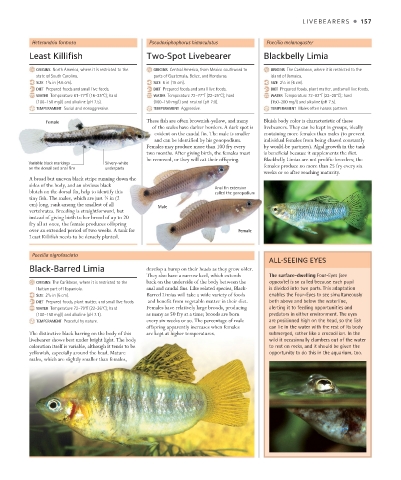
              Female                     These fish are often brownish-yellow, and many    Bluish body color is characteristic of these
                                           of the scales have darker borders. A dark spot is   livebearers. They can be kept in groups, ideally
                                            evident on the caudal fin. The male is smaller   containing more females than males (to prevent
                                            and can be identified by his gonopodium.   individual females from being chased constantly
                                         Females may produce more than 100 fry every   by would-be partners). Algal growth in the tank
                                         two months. After giving birth, the females must   is beneficial because it supplements the diet.
                                         be removed, or they will eat their offspring.  Blackbelly Limias are not prolific breeders; the
         Variable black markings    Silvery-white
         on the dorsal and anal fins  underparts                          females produce no more than 25 fry every six
                                                                          weeks or so after reaching maturity.
         A broad but uneven black stripe running down the
         sides of the body, and an obvious black            Anal fin extension
         blotch on the dorsal fin, help to identify this    called the gonopodium
                              3
         tiny fish. The males, which are just  ⁄4 in (2
         cm) long, rank among the smallest of all   Male
         vertebrates. Breeding is straightforward, but
         instead of giving birth to her brood of up to 20
         fry all at once, the female produces offspring
         over an extended period of two weeks. A tank for          Female
         Least Killifish needs to be densely planted.
          Poecilia nigrofasciata
                                                                           ALL-SEEING EYES
         Black-Barred Limia              develop a hump on their heads as they grow older.
                                         They also have a narrow keel, which extends    The surface-dwelling Four-Eyes (see
           ORIGINS  The Caribbean, where it is restricted to the   back on the underside of the body between the   opposite) is so called because each pupil
           Haitian part of Hispaniola.   anal and caudal fins. Like related species, Black-   is divided into two parts. This adaptation
           SIZE  2 ⁄2 in (6 cm).         Barred Limias will take a wide variety of foods   enables the Four-Eyes to see simultaneously
              1
           DIET  Prepared foods, plant matter, and small live foods.   and benefit from vegetable matter in their diet.   both above and below the waterline,
           WATER  Temperature 72–79°F (22–26°C); hard   Females have relatively large broods, producing    alerting it to feeding opportunities and
           (100–150 mg/l) and alkaline (pH 7.1).  as many as 50 fry at a time; broods are born    predators in either environment. The eyes
           TEMPERAMENT  Peaceful by nature.  every six weeks or so. The percentage of male   are positioned high on the head, so the fish
                                         offspring apparently increases when females    can lie in the water with the rest of its body
         The distinctive black barring on the body of this   are kept at higher temperatures.  submerged, rather like a crocodilian. In the
         livebearer shows best under bright light. The body                wild it occasionally clambers out of the water
         coloration itself is variable, although it tends to be            to rest on rocks, and it should be given the
         yellowish, especially around the head. Mature                     opportunity to do this in the aquarium, too.
         males, which are slightly smaller than females,


   US_156-157_Live_bearers_Intro.indd   157                                                          29/08/18   4:09 PM

