


Page 176 - Encyclopedia of Aquarium and Pond Fish, 3rd Edition
P. 176
174    FRESHWATER FISH DIRECTORY


                                                                          Epiplatys fasciolatus
           UNUSUAL KILLIFISH
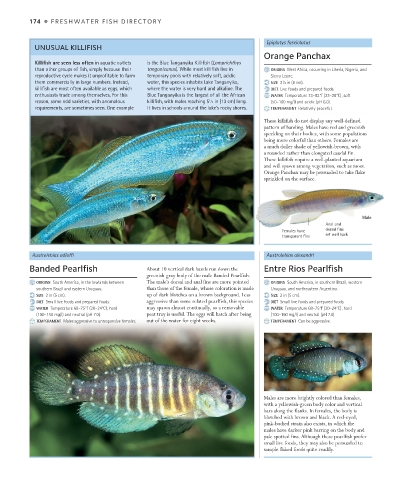
                                                                          Orange Panchax
           Killifish are seen less often in aquatic outlets   is the Blue Tanganyika Killifish (Lamprichthys
           than other groups of fish, simply because their   tanganicanus). While most killifish live in   ORIGINS  West Africa, occurring in Liberia, Nigeria, and
           reproductive cycle makes it unprofitable to farm   temporary pools with relatively soft, acidic   Sierra Leone.
           them commercially in large numbers. Instead,   water, this species inhabits Lake Tanganyika,   SIZE  3 ⁄4 in (8 cm).
                                                                               1
           killifish are most often available as eggs, which   where the water is very hard and alkaline. The   DIET  Live foods and prepared foods.
           enthusiasts trade among themselves. For this   Blue Tanganyika is the largest of all the African   WATER  Temperature 73–82°F (23–28°C); soft
           reason, some odd varieties, with anomalous   killifish, with males reaching 5 ⁄2 in (13 cm) long.    (50–100 mg/l) and acidic (pH 6.0).
                                                           1
           requirements, are sometimes seen. One example   It lives in schools around the lake’s rocky shores.  TEMPERAMENT  Relatively peaceful.
                                                                          These killifish do not display any well-defined
                                                                          pattern of banding. Males have red and greenish
                                                                          speckling on their bodies, with some populations
                                                                          being more colorful than others. Females are
                                                                          a much duller shade of yellowish-brown, with
                                                                          a rounded rather than elongated caudal fin.
                                                                          These killifish require a well-planted aquarium
                                                                          and will spawn among vegetation, such as moss.
                                                                          Orange Panchax may be persuaded to take flake
                                                                          sprinkled on the surface.


                                                                                                     Male
                                                                                           Anal and
                                                                               Females have   dorsal fins
                                                                               transparent fins  set well back

          Austrolebias adloffi                                            Austrolebias alexandri
         Banded Pearlfish                About 10 vertical dark bands run down the   Entre Rios Pearlfish
                                         greenish-gray body of the male Banded Pearlfish.
           ORIGINS  South America, in the lowlands between   The male’s dorsal and anal fins are more pointed   ORIGINS  South America, in southern Brazil, western
           southern Brazil and eastern Uruguay.   than those of the female, whose coloration is made   Uruguay, and northeastern Argentina.
           SIZE  2 in (5 cm).            up of dark blotches on a brown background. Less   SIZE  2 in (5 cm).
           DIET  Small live foods and prepared foods.  aggressive than some related pearlfish, this species   DIET  Small live foods and prepared foods.
           WATER  Temperature 68–75°F (20–24°C); hard    may spawn almost continually, so a removable    WATER  Temperature 68–75°F (20–24°C); hard
           (100–150 mg/l) and neutral (pH 7.0).  peat tray is useful. The eggs will hatch after being   (100–150 mg/l) and neutral (pH 7.0).
           TEMPERAMENT  Males aggressive to unresponsive females.  out of the water for eight weeks.  TEMPERAMENT  Can be aggressive.


                                                                          Males are more brightly colored than females,
                                                                          with a yellowish-green body color and vertical
                                                                          bars along the flanks. In females, the body is
                                                                          blotched with brown and black. A red-eyed,
                                                                          pink-bodied strain also exists, in which the
                                                                          males have darker pink barring on the body and
                                                                          pale spotted fins. Although these pearlfish prefer
                                                                          small live foods, they may also be persuaded to
                                                                          sample flaked foods quite readily.


   US_174-175_Killifish.indd   174                                                                   29/08/18   4:09 PM

