


Page 177 - Encyclopedia of Aquarium and Pond Fish, 3rd Edition
P. 177
KILLIFISH     175


          Austrolebias nigripinnis        Cynopoecilus melanotaenia       Simpsonichthys bokermanni
         Black-Finned Pearlfish          Fighting Gaucho                  Bokerman’s Cynolebias

           ORIGINS  South America, in Argentina and also in parts   ORIGINS  South America, occurring in both southeastern   ORIGINS  South America, restricted to pools close to
           of southern Brazil and Uruguay.  Brazil and northern Uruguay.    Ilheus, Bahia, near the Brazilian coast.
           SIZE  2 in (5 cm).              SIZE  2 in (5 cm).               SIZE  2 in (5 cm).
           DIET  Small live foods and prepared foods.  DIET  Small live foods and prepared foods.  DIET  Small live foods and prepared foods.
           WATER  Temperature 68–72°F (20–22°C); soft    WATER  Temperature 64–75°F (18–24°C); soft   WATER  Temperature 68–75°F (20–24°C); soft
           (50–100 mg/l) and acidic (pH 6.0).  (50–100 mg/l) and acidic (pH 6.5).  (50–100 mg/l) and acidic (pH 6.0).
           TEMPERAMENT  Can be aggressive.  TEMPERAMENT  Aggressive toward its own kind.  TEMPERAMENT  Can be aggressive.
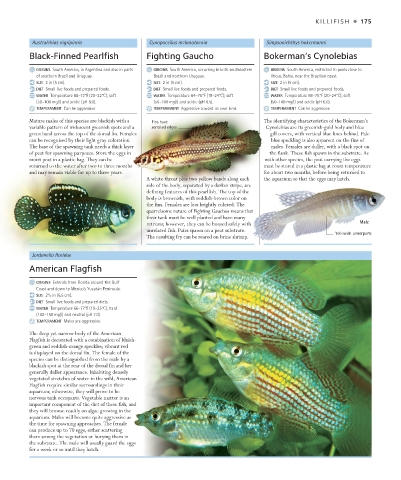
         Mature males of this species are blackish with a   Fins have     The identifying characteristics of the Bokerman’s
         variable pattern of iridescent greenish spots and a   serrated edges  Cynolebias are its greenish-gold body and blue
         green band across the top of the dorsal fin. Females               gill covers, with vertical blue lines behind. Pale
         can be recognized by their light gray coloration.                  blue speckling is also apparent on the fins of
         The base of the spawning tank needs a thick layer                  males. Females are duller, with a black spot on
         of peat for spawning purposes. Store the eggs in                  the flank. These fish spawn in the substrate. As
         moist peat in a plastic bag. They can be                         with other species, the peat carrying the eggs
         returned to the water after two to three months                  must be stored in a plastic bag at room temperature
         and may remain viable for up to three years.                     for about two months, before being returned to
                                         A white throat plus two yellow bands along each   the aquarium so that the eggs may hatch.
                                         side of the body, separated by a darker stripe, are
                                         defining features of this pearlfish. The top of the
                                         body is brownish, with reddish-brown color on
                                         the fins. Females are less brightly colored. The
                                         quarrelsome nature of Fighting Gauchos means that
                                         their tank must be well planted and have many
                                         retreats; however, they can be housed safely with          Male
                                         unrelated fish. Pairs spawn on a peat substrate.    Yellowish underparts
                                         The resulting fry can be reared on brine shrimp.

          Jordanella floridae
         American Flagfish

           ORIGINS  Extends from Florida around the Gulf
           Coast and down to Mexico’s Yucatán Peninsula.
           SIZE  2 ⁄2 in (6.5 cm).
              1
           DIET  Small live foods and prepared diets.
           WATER  Temperature 66–77°F (19–25°C); hard
           (100–150 mg/l) and neutral (pH 7.0).
           TEMPERAMENT  Males are aggressive.
         The deep yet narrow body of the American
         Flagfish is decorated with a combination of bluish-
         green and reddish-orange speckles; vibrant red
         is displayed on the dorsal fin. The female of the
         species can be distinguished from the male by a
         blackish spot at the rear of the dorsal fin and her
         generally duller appearance. Inhabiting densely
         vegetated stretches of water in the wild, American
         Flagfish require similar surroundings in their
         aquarium; otherwise, they will prove to be
         nervous tank occupants. Vegetable matter is an
         important component of the diet of these fish, and
         they will browse readily on algae growing in the
         aquarium. Males will become quite aggressive as
         the time for spawning approaches. The female
         can produce up to 70 eggs, either scattering
         them among the vegetation or burying them in
         the substrate. The male will usually guard the eggs
         for a week or so until they hatch.


   US_174-175_Killifish.indd   175                                                                   29/08/18   4:09 PM

