


Page 179 - Encyclopedia of Aquarium and Pond Fish, 3rd Edition
P. 179
RAINBOWFISH    177


          Chilatherina bleheri            Pseudomugil signifer            Pseudomugil furcatus
         Bleher’s Rainbowfish            Australian Blue-Eye              Forktailed Blue Eye

           ORIGINS  New Guinea, occurring in Lake Holmes and   ORIGINS  Australia, from northern Queensland    ORIGINS  Eastern New Guinea, occurring between
           associated streams, and in Mamberamo, Irian Jaya.  southward to Narooma in New South Wales.  Collingwood and Dyke Ackland Bays.
           SIZE  4 ⁄4 in (12 cm).          SIZE  2 ⁄2 in (6 cm).            SIZE  2 ⁄2 in (6 cm).
                                               1
              3
                                                                               1
           DIET  Prefers small live foods.  DIET  Eats both prepared diets and small live foods.  DIET  Small live foods preferred.
           WATER  Temperature 77–86°F (25–30°C); hard    WATER  Temperature 59–82°F (15–28°C); soft    WATER  Temperature 73–79°F (23–26°C); soft to hard
           (150–200 mg/l) and neutral (pH 7.0).   (50–100 mg/l) and acidic to alkaline (pH 5.5–7.8).  (50–150 mg/l) and neutral to alkaline (pH 7.0– 8.0).
           TEMPERAMENT  Peaceful.          TEMPERAMENT  Territorial when spawning.  TEMPERAMENT  Peaceful.
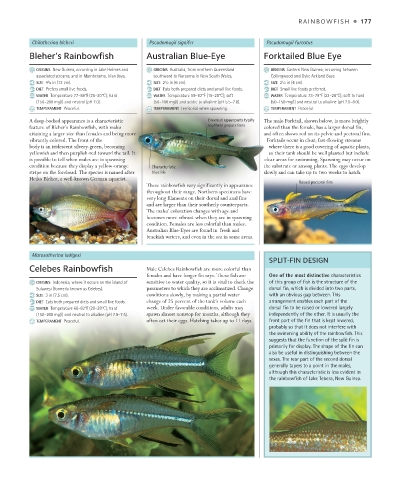
         A deep-bodied appearance is a characteristic     Greenish upperparts typify   The male Forktail, shown below, is more brightly
         feature of Bleher’s Rainbowfish, with males      southern populations  colored than the female, has a larger dorsal fin,
         attaining a larger size than females and being more              and often shows red on its pelvic and pectoral fins.
         vibrantly colored. The front of the                               Forktails occur in clear, fast-flowing streams
         body is an iridescent silvery-green, becoming                     where there is a good covering of aquatic plants,
         yellowish and then purplish-red toward the tail. It               so their tank should be well planted but include
         is possible to tell when males are in spawning                   clear areas for swimming. Spawning may occur on
         condition because they display a yellow-orange   Characteristic   the substrate or among plants. The eggs develop
         stripe on the forehead. The species is named after   blue iris   slowly and can take up to two weeks to hatch.
         Heiko Bleher, a well-known German aquarist.                               Raised pectoral fins
                                         These rainbowfish vary significantly in appearance
                                         throughout their range. Northern specimens have
                                         very long filaments on their dorsal and anal fins
                                         and are larger than their southerly counterparts.
                                         The males’ coloration changes with age and
                                         becomes more vibrant when they are in spawning
                                         condition. Females are less colorful than males.
                                         Australian Blue-Eyes are found in  fresh and
                                         brackish waters, and even in the sea in some areas.

          Marosatherina ladigesi
                                                                           SPLIT-FIN DESIGN
         Celebes Rainbowfish             Male Celebes Rainbowfish are more colorful than
                                         females and have longer fin rays. These fish are   One of the most distinctive characteristics
           ORIGINS  Indonesia, where it occurs on the island of   sensitive to water quality, so it is vital to check the   of this group of fish is the structure of the
           Sulawesi (formerly known as Celebes).  parameters to which they are acclimatized. Change   dorsal fin, which is divided into two parts,
           SIZE  3 in (7.5 cm).          conditions slowly, by making a partial water   with an obvious gap between. This
           DIET  Eats both prepared diets and small live foods.  change of 25 percent of the tank’s volume each   arrangement enables each part of the
           WATER  Temperature 68–82°F (20–28°C); hard   week. Under favorable conditions, adults may   dorsal fin to be raised or lowered largely
           (150–200 mg/l) and neutral to alkaline (pH 7.0–7.5).   spawn almost nonstop for months, although they   independently of the other. It is usually the
           TEMPERAMENT  Peaceful.        often eat their eggs. Hatching takes up to 11 days.  front part of the fin that is kept lowered,
                                                                           probably so that it does not interfere with
                                                                           the swimming ability of the rainbowfish. This
                                                                           suggests that the function of the split fin is
                                                                           primarily for display. The shape of the fin can
                                                                           also be useful in distinguishing between the
                                                                           sexes. The rear part of the second dorsal
                                                                           generally tapers to a point in the males,
                                                                           although this characteristic is less evident in
                                                                           the rainbowfish of Lake Tebera, New Guinea.


   US_176-177_Rainbow_fish_intro.indd   177                                                          29/08/18   4:10 PM

