


Page 188 - Encyclopedia of Aquarium and Pond Fish, 3rd Edition
P. 188
186    FRESHWATER FISH DIRECTORY

         OTHER AFRICAN SPECIES


         Africa is home to a wide range of unique and fascinating
         fish. The fossil record shows that some of these, notably
         the African lungfish (see opposite), have altered relatively
         little over millions of years. Lungfish and similar species,
         such as Cuvier’s Bichir, are most likely to be seen in
         specialist aquatic stores, partly because they can be
         difficult to keep. The long-snouted mormyrids, or
         “elephant fish,” rank among the most popular of
         the other African groups, thanks to their bizarre
         appearance. They also have the ability to
         generate weak electrical currents.

         Like the lungfish, Africa’s Reed Fish
         (Erpetoichthys calabaricus) can breathe out of
         water thanks to its swim bladder, which takes
         over the job of oxygenating the blood when
         the gills cannot function as normal.

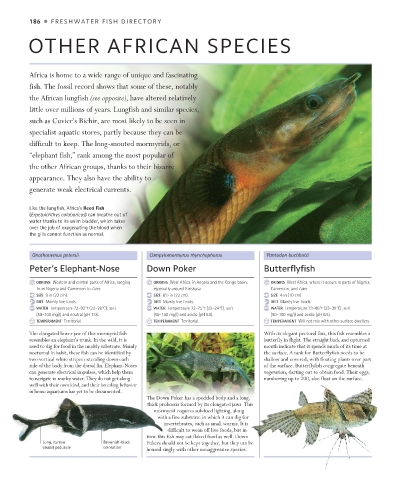
          Gnathonemus petersii            Campylomormyrus rhynchophorus   Pantodon buchholzi
         Peter’s Elephant-Nose           Down Poker                       Butterflyfish

           ORIGINS  Western and central parts of Africa, ranging   ORIGINS  West Africa, in Angola and the Congo basin,   ORIGINS  West Africa, where it occurs in parts of Nigeria,
           from Nigeria and Cameroon to Zaire.   especially around Kinshasa.  Cameroon, and Zaire.
           SIZE  9 in (23 cm).             SIZE  8 ⁄2 in (22 cm).           SIZE  4 in (10 cm).
                                               1
           DIET  Mainly live foods.        DIET  Mainly live foods.         DIET  Mainly live foods.
           WATER  Temperature 72–82°F (22–28°C); soft    WATER  Temperature 72–75°F (22–24°C); soft    WATER  Temperature 73–86°F (23–30°C); soft
           (50–100 mg/l) and neutral (pH 7.0).  (50–100 mg/l) and acidic (pH 5.0).   (50–100 mg/l) and acidic (pH 6.5).
           TEMPERAMENT  Territorial.       TEMPERAMENT  Territorial.        TEMPERAMENT  Will not mix with other surface dwellers.
         The elongated lower jaw of this mormyrid fish                    With its elegant pectoral fins, this fish resembles a
         resembles an elephant’s trunk. In the wild, it is                butterfly in flight. The straight back and upturned
         used to dig for food in the muddy substrate. Mainly              mouth indicate that it spends much of its time at
         nocturnal in habit, these fish can be identified by              the surface. A tank for Butterflyfish needs to be
         two vertical white stripes extending down each                   shallow and covered, with floating plants over part
         side of the body from the dorsal fin. Elephant-Noses             of the surface. Butterflyfish congregate beneath
         can generate electrical impulses, which help them                vegetation, darting out to obtain food. Their eggs,
         to navigate in murky water. They do not get along                numbering up to 200, also float on the surface.
         well with their own kind, and their breeding behavior
         in home aquariums has yet to be documented.
                                         The Down Poker has a speckled body and a long,
                                          thick proboscis formed by its elongated jaws. This
                                           mormyrid requires subdued lighting, along
                                            with a fine substrate in which it can dig for
                                              invertebrates, such as small worms. It is
                                               difficult to wean off live foods, but in
                                         time this fish may eat flaked food as well. Down
             Long, narrow     Brownish-black   Pokers should not be kept together, but they can be
             caudal peduncle  coloration
                                         housed singly with other nonaggressive species.


   US_186-187_Oth_African_Sp.indd   186                                                              29/08/18   4:10 PM

