


Page 184 - Encyclopedia of Aquarium and Pond Fish, 3rd Edition
P. 184
182    FRESHWATER FISH DIRECTORY

         OTHER AMERICAN SPECIES


         This varied selection of popular American species
         demonstrates the amazing adaptability of fish. For
         example, the Amazon Puffer, whose relatives are
         confined to marine and brackish waters, has
         changed its body chemistry to enable it to
         exploit salt-free environments. In other
         species, such as Knifefish, Ocellated
         Stingrays, and Violet Gobies, the body shape
         has altered to help the fish merge into the
         background or enable them to burrow in the
         substrate. The streamlined Arawana, which
         lurks much closer to the surface, has developed
         the ability to breathe atmospheric air directly,
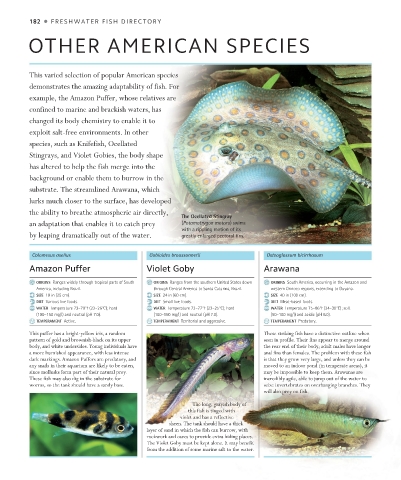
                                                   The Ocellated Stingray
         an adaptation that enables it to catch prey    (Potamotrygon motoro) swims
                                                   with a rippling motion of its
         by leaping dramatically out of the water.  greatly enlarged pectoral fins.

          Colomesus asellus               Gobioides broussonnetii         Osteoglossum bicirrhosum
         Amazon Puffer                   Violet Goby                      Arawana

           ORIGINS  Ranges widely through tropical parts of South   ORIGINS  Ranges from the southern United States down   ORIGINS  South America, occurring in the Amazon and
           America, including Brazil.      through Central America to Santa Catarina, Brazil.  western Orinoco regions, extending to Guyana.
           SIZE  10 in (25 cm).            SIZE  24 in (60 cm).             SIZE  40 in (100 cm).
           DIET  Various live foods.       DIET  Small live foods.          DIET  Meat-based foods.
           WATER  Temperature 73–79°F (23–26°C); hard    WATER  Temperature 73–77°F (23–25°C); hard   WATER  Temperature 75–86°F (24–30°C); soft
           (100–150 mg/l) and neutral (pH 7.0).   (100–150 mg/l) and neutral (pH 7.0).  (50–100 mg/l) and acidic (pH 6.0).
           TEMPERAMENT  Active.            TEMPERAMENT  Territorial and aggressive.  TEMPERAMENT  Predatory.
         This puffer has a bright-yellow iris, a random                   These striking fish have a distinctive outline when
         pattern of gold and brownish-black on its upper                  seen in profile. Their fins appear to merge around
         body, and white undersides. Young individuals have               the rear end of their body; adult males have longer
         a more burnished appearance, with less intense                   anal fins than females. The problem with these fish
         dark markings. Amazon Puffers are predatory, and                 is that they grow very large, and unless they can be
         any snails in their aquarium are likely to be eaten,             moved to an indoor pond (in temperate areas), it
         since mollusks form part of their natural prey.                  may be impossible to keep them. Arawanas are
         These fish may also dig in the substrate for                     incredibly agile, able to jump out of the water to
         worms, so the tank should have a sandy base.                     seize invertebrates on overhanging branches. They
                                                                          will also prey on fish.
                                                      The long, grayish body of
                                                     this fish is tinged with
                                                   violet and has a reflective
                                                sheen. The tank should have a thick
                                         layer of sand in which the fish can burrow, with
                                         rockwork and caves to provide extra hiding places.
                                         The Violet Goby must be kept alone. It may benefit
                                         from the addition of some marine salt to the water.


   US_182-183_American_species.indd   182                                                            29/08/18   4:10 PM

