


Page 185 - Encyclopedia of Aquarium and Pond Fish, 3rd Edition
P. 185
OTHER AMERICAN SPECIES    183


          Apteronotus albifrons
                                           STING IN THE TAIL
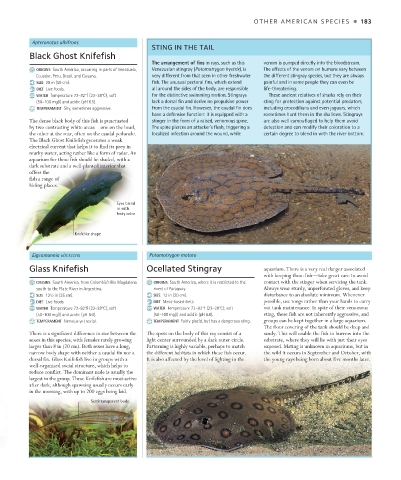
         Black Ghost Knifefish
                                           The arrangement of fins in rays, such as this   venom is pumped directly into the bloodstream.
           ORIGINS  South America, occurring in parts of Venezuela,   Venezuelan stingray (Potamotrygon hystrix), is   The effects of the venom on humans vary between
           Ecuador, Peru, Brazil, and Guyana.  very different from that seen in other freshwater   the different stingray species, but they are always
           SIZE  20 in (50 cm).            fish. The unusual pectoral fins, which extend    painful and in some people they can even be
           DIET  Live foods.               all around the sides of the body, are responsible   life-threatening.
           WATER  Temperature 73–82°F (23–28°C); soft    for the distinctive swimming motion. Stingrays     These ancient relatives of sharks rely on their
           (50–100 mg/l) and acidic (pH 6.5).   lack a dorsal fin and derive no propulsive power   sting for protection against potential predators,
           TEMPERAMENT  Shy, sometimes aggressive.  from the caudal fin. However, the caudal fin does   including crocodilians and even jaguars, which
                                           have a defensive function: it is equipped with a   sometimes hunt them in the shallows. Stingrays
         The dense black body of this fish is punctuated    stinger in the form of a raised, venomous spine.   are also well camouflaged to help them avoid
         by two contrasting white areas—one on the head,   The spine pierces an attacker’s flesh, triggering a   detection and can modify their coloration to a
         the other at the rear, often on the caudal peduncle.   localized infection around the wound, while   certain degree to blend in with the river bottom.
         The Black Ghost Knifefish generates a weak
         electrical current that helps it to find its prey in
         murky water, acting rather like a form of radar. An
         aquarium for these fish should be shaded, with a
         dark substrate and a well-planted interior that
         offers the
         fish a range of
         hiding places.

                                 Eyes blend
                                 in with
                                 body color


                      Knifelike shape

          Eigenmannia virescens           Potamotrygon motoro
         Glass Knifefish                 Ocellated Stingray               aquarium. There is a very real danger associated
                                                                          with keeping these fish—take great care to avoid
           ORIGINS  South America, from Colombia’s Rio Magdalena   ORIGINS  South America, where it is restricted to the   contact with the stinger when servicing the tank.
           south to the Plate River in Argentina.  rivers of Paraguay.    Always wear sturdy, unperforated gloves, and keep
           SIZE  13 ⁄2 in (35 cm).         SIZE  12 in (30 cm).           disturbance to an absolute minimum. Whenever
               1
           DIET  Live foods.               DIET  Meat-based diets.        possible, use tongs rather than your hands to carry
           WATER  Temperature 73–82°F (23–28°C); soft   WATER  Temperature 73–82°F (23–28°C); soft    out tank maintenance. In spite of their venomous
           (50–100 mg/l) and acidic (pH 6.0).  (50–100 mg/l) and acidic (pH 6.0).  sting, these fish are not inherently aggressive, and
           TEMPERAMENT  Nervous yet social.  TEMPERAMENT  Fairly placid, but has a dangerous sting.  groups can be kept together in a large aquarium.
                                                                          The floor covering of the tank should be deep and
         There is a significant difference in size between the   The spots on the body of this ray consist of a    sandy. This will enable the fish to burrow into the
         sexes in this species, with females rarely growing   light center surrounded by a dark outer circle.   substrate, where they will lie with just their eyes
         larger than 8 in (20 cm). Both sexes have a long,   Patterning is highly variable, perhaps to match    exposed. Mating is unknown in aquariums, but in
         narrow body shape with neither a caudal fin nor a   the different habitats in which these fish occur.    the wild it occurs in September and October, with
         dorsal fin. Glass Knifefish live in groups with a   It is also affected by the level of lighting in the   the young rays being born about five months later.
         well-organized social structure, which helps to
         reduce conflict. The dominant male is usually the
         largest in the group. These Knifefish are most active
         after dark, although spawning usually occurs early
         in the morning, with up to 200 eggs being laid.
                          Semitransparent body


   US_182-183_American_species.indd   183                                                            29/08/18   4:10 PM

