


Page 183 - Encyclopedia of Aquarium and Pond Fish, 3rd Edition
P. 183
LOACHES     181


          Chromobotia macracanthus        Botia striata                   Yasuhikotakia modesta
         Clown Loach                     Zebra Loach                      Redtail Loach

           ORIGINS  Southeast Asia, where it occurs in various parts   ORIGINS  Asia, restricted to muddy waters in parts of   ORIGINS  Asia, including northeast India, Vietnam,
           of Indonesia, including Sumatra, and on Borneo.   southern India.  Thailand, and the Malay Peninsula.
           SIZE  12 in (30 cm).            SIZE  4 in (10 cm).              SIZE  9 ⁄2 in (24 cm).
                                                                               1
           DIET  Prepared foods and live foods.  DIET  Prepared foods of all types.  DIET  Prepared foods and live foods.
           WATER  Temperature 75–86°F (24–30°C); soft (50 mg/l)   WATER  Temperature 75–86°F (24–30°C); soft (50 mg/l)   WATER  Temperature 75–86°F (24–30°C); soft (50 mg/l)
           and acidic (pH 6.0–6.5).        and acidic (pH 6.0–6.5).         and acidic (pH 6.0–6.5).
           TEMPERAMENT  Usually active and lively.  TEMPERAMENT  Nonaggressive.  TEMPERAMENT  Shy.
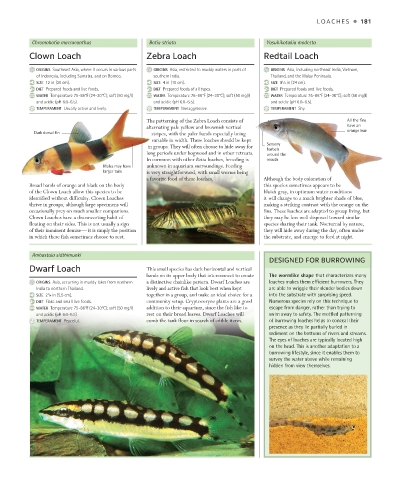
                                         The patterning of the Zebra Loach consists of           All the fins
                                         alternating pale yellow and brownish vertical           have an
          Dark dorsal fin                  stripes, with the paler bands especially being        orange hue
                                           variable in width. These loaches should be kept
                                          in groups. They will often choose to hide away for   Sensory
                                                                           barbels
                                         long periods under bogwood and in other retreats.   around the
                                         In common with other Botia loaches, breeding is   mouth
                             Males may have   unknown in aquarium surroundings. Feeding
                             larger tails  is very straightforward, with small worms being
                                         a favorite food of these loaches.  Although the body coloration of
         Broad bands of orange and black on the body                      this species sometimes appears to be
         of the Clown Loach allow this species to be                      bluish-gray, in optimum water conditions
         identified without difficulty. Clown Loaches                     it will change to a much brighter shade of blue,
         thrive in groups, although large specimens will                  making a striking contrast with the orange on the
         occasionally prey on much smaller companions.                    fins. These loaches are adapted to group living, but
         Clown Loaches have a disconcerting habit of                      they may be less well disposed toward similar
         floating on their sides. This is not usually a sign              species sharing their tank. Nocturnal by nature,
         of their imminent demise— it is simply the position              they will hide away during the day, often under
         in which these fish sometimes choose to rest.                    the substrate, and emerge to feed at night.

          Ambastaia sidthimunki
                                                                           DESIGNED FOR BURROWING
         Dwarf Loach                     This small species has dark horizontal and vertical
                                         bands on its upper body that interconnect to create   The wormlike shape that characterizes many
           ORIGINS  Asia, occurring in muddy lakes from northern   a distinctive chainlike pattern. Dwarf Loaches are   loaches makes them efficient burrowers. They
           India to northern Thailand.   lively and active fish that look best when kept   are able to wriggle their slender bodies down
           SIZE  2 ⁄4 in (5.5 cm).       together in a group, and make an ideal choice for a   into the substrate with surprising speed.
              1
           DIET  Flake and small live foods.  community setup. Cryptocoryne plants are a good   Numerous species rely on this technique to
           WATER  Temperature 75–86°F (24–30°C); soft (50 mg/l)   addition to their aquarium, since the fish like to   escape from danger, rather than trying to
           and acidic (pH 6.0–6.5).      rest on their broad leaves. Dwarf Loaches will   swim away to safety. The mottled patterning
           TEMPERAMENT  Peaceful.        comb the tank floor in search of edible items.  of burrowing loaches helps to conceal their
                                                                           presence as they lie partially buried in
                                                                           sediment on the bottoms of rivers and streams.
                                                                           The eyes of loaches are typically located high
                                                                           on the head. This is another adaptation to a
                                                                           burrowing lifestyle, since it enables them to
                                                                           survey the water above while remaining
                                                                           hidden from view themselves.


   US_180-181_Loaches.indd   181                                                                    14/09/18   12:07 PM

