


Page 191 - Encyclopedia of Aquarium and Pond Fish, 3rd Edition
P. 191
BRACKISH WATER SPECIES    189


          Macrognathus aculeatus          Periophthalmus barbarus
                                                                           SANCTUARY IN THE SWAMP
         Lesser Spiny Eel                Mudskipper
                                                                           Mangrove swamps occur in tidal areas, often
           ORIGINS  Southeast Asia, in brackish environments close   ORIGINS  East Africa, south to Madagascar, and east to   close to estuaries, where salt-tolerant plants
           to the shoreline.               parts of southeast Asia and Australia.   grow in the mud. The tangled mass of the
           SIZE  14 in (35 cm).            SIZE  6 in (15 cm).             plants’ submerged roots provides sanctuary
           DIET  Live foods of different types.   DIET  Live foods of all types.   for the young of fish, such as the Tiger Scat
           WATER  Temperature 73–82°F (23–28°C); alkaline   WATER  Temperature 77–86°F (25–30°C); alkaline   (see bottom left), which slip easily between
           (pH 7.6–8.0) with SG 1.002–1.007.   (pH 7.6–8.0) with SG 1.002–1.007.   the roots and out of reach of larger predators.
           TEMPERAMENT  Predatory and aggressive.  TEMPERAMENT  Territorial.  Mudskippers in particular have adapted to
                                                                           the mangroves, because they can survive
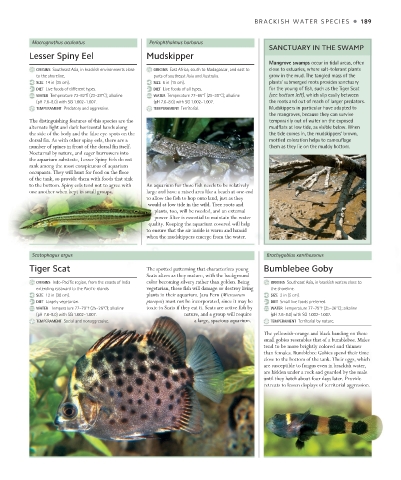
         The distinguishing features of this species are the               temporarily out of water on the exposed
         alternate light and dark horizontal bands along                   mudflats at low tide, as visible below. When
         the side of the body and the false eye-spots on the               the tide comes in, the mudskippers’ brown,
         dorsal fin. As with other spiny eels, there are a                 mottled coloration helps to camouflage
         number of spines in front of the dorsal fin itself.               them as they lie on the muddy bottom.
         Nocturnal by nature, and eager burrowers into
         the aquarium substrate, Lesser Spiny Eels do not
         rank among the most conspicuous of aquarium
         occupants. They will hunt for food on the floor
         of the tank, so provide them with foods that sink
         to the bottom. Spiny eels tend not to agree with   An aquarium for these fish needs to be relatively
         one another when kept in small groups.  large and have a raised area like a beach at one end
                                         to allow the fish to hop onto land, just as they
                                          would at low tide in the wild. Tree roots and
                                            plants, too, will be needed, and an external
                                            power filter is essential to maintain the water
                                          quality. Keeping the aquarium covered will help
                                         to ensure that the air inside is warm and humid
                                         when the mudskippers emerge from the water.

          Scatophagus argus                                               Brachygobius xanthozonus
         Tiger Scat                      The spotted patterning that characterizes young   Bumblebee Goby
                                         Scats alters as they mature, with the background
           ORIGINS  Indo-Pacific region, from the coasts of India   color becoming silvery rather than golden. Being   ORIGINS  Southeast Asia, in brackish waters close to
           extending eastward to the Pacific islands.  vegetarian, these fish will damage or destroy living   the shoreline.
           SIZE  12 in (30 cm).          plants in their aquarium. Java Fern (Microsorum   SIZE  2 in (5 cm).
           DIET  Largely vegetarian.     pteropus) must not be incorporated, since it may be   DIET  Small live foods preferred.
           WATER   Temperature 77–79°F (25–26°C); alkaline   toxic to Scats if they eat it. Scats are active fish by   WATER  Temperature 77–79°F (25–26°C); alkaline
           (pH 7.6–8.0) with SG 1.002–1.007.        nature, and a group will require   (pH 7.6–8.0) with SG 1.002–1.007.
           TEMPERAMENT  Social and nonaggressive.      a large, spacious aquarium.  TEMPERAMENT  Territorial by nature.
                                                                          The yellowish-orange and black banding on these
                                                                          small gobies resembles that of a bumblebee. Males
                                                                          tend to be more brightly colored and thinner
                                                                          than females. Bumblebee Gobies spend their time
                                                                          close to the bottom of the tank. Their eggs, which
                                                                          are susceptible to fungus even in brackish water,
                                                                          are hidden under a rock and guarded by the male
                                                                          until they hatch about four days later. Provide
                                                                          retreats to lessen displays of territorial aggression.


   US_188-189_Brackish_Water.indd   189                                                              29/08/18   4:10 PM

