


Page 190 - Encyclopedia of Aquarium and Pond Fish, 3rd Edition
P. 190
188    FRESHWATER FISH DIRECTORY

         BRACKISH WATER SPECIES


         A brackish-water tank lets you keep a number of
         interesting, but often overlooked, species that are
         native to estuarine waters. The home aquarium
         can be a mixed community setup, or a
         recreation of a specialized habitat such
         as a swamp. It could incorporate mangrove
         plants and mudskippers (see p.43), which
         venture out of water more regularly than
         any other fish. Brackish-water tanks are
         not difficult to maintain; correct water
         conditions are initially achieved by adding
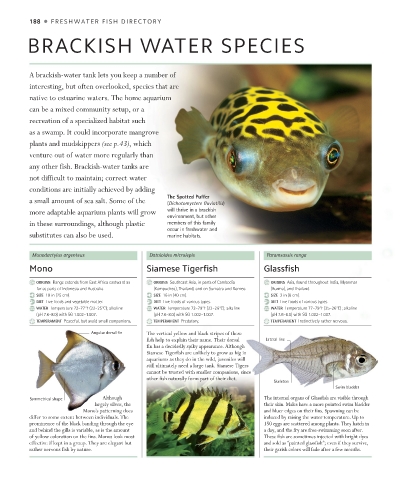
                                               The Spotted Puffer
         a small amount of sea salt. Some of the   (Dichotomyctere fluviatilis)
         more adaptable aquarium plants will grow   will thrive in a brackish
                                               environment, but other
         in these surroundings, although plastic   members of this family
                                               occur in freshwater and
         substitutes can also be used.         marine habitats.

          Monodactylus argenteus          Datnioides microlepis           Paramsassis ranga
         Mono                            Siamese Tigerfish                Glassfish

           ORIGINS  Range extends from East Africa eastward as    ORIGINS  Southeast Asia, in parts of Cambodia   ORIGINS  Asia, found throughout India, Myanmar
           far as parts of Indonesia and Australia.  (Kampuchea), Thailand, and on Sumatra and Borneo.   (Burma), and Thailand.
           SIZE  10 in (25 cm).            SIZE  16 in (40 cm).             SIZE  3 in (8 cm).
           DIET  Live foods and vegetable matter.   DIET  Live foods of various types.   DIET  Live foods of various types.
           WATER  Temperature 72–77°F (22–25°C); alkaline   WATER  Temperature 72–79°F (22–26°C); alkaline   WATER  Temperature 77–79°F (25–26°C); alkaline
           (pH 7.6–8.0) with SG 1.002–1.007.   (pH 7.6–8.0) with SG 1.002–1.007.   (pH 7.6–8.0) with SG 1.002–1.007.
           TEMPERAMENT  Peaceful, but avoid small companions.  TEMPERAMENT  Predatory.  TEMPERAMENT  Instinctively rather nervous.
                          Angular dorsal fin  The vertical yellow and black stripes of these
                                         fish help to explain their name. Their dorsal    Lateral line
                                         fin has a decidedly spiky appearance. Although
                                         Siamese Tigerfish are unlikely to grow as big in
                                         aquariums as they do in the wild, juveniles will
                                         still ultimately need a large tank. Siamese Tigers
                                         cannot be trusted with smaller companions, since
                                         other fish naturally form part of their diet.
                                                                             Skeleton
                                                                                              Swim bladder
         Symmetrical shape   Although                                     The internal organs of Glassfish are visible through
                           largely silver, the                            their skin. Males have a more pointed swim bladder
                        Mono’s patterning does                            and bluer edges on their fins. Spawning can be
         differ to some extent between individuals. The                   induced by raising the water temperature. Up to
         prominence of the black banding through the eye                  150 eggs are scattered among plants. They hatch in
         and behind the gills is variable, as is the amount               a day, and the fry are free-swimming soon after.
         of yellow coloration on the fins. Monos look most                These fish are sometimes injected with bright dyes
         effective if kept in a group. They are elegant but               and sold as “painted glassfish”; even if they survive,
         rather nervous fish by nature.                                   their garish colors will fade after a few months.


   US_188-189_Brackish_Water.indd   188                                                              29/08/18   4:10 PM

