


Page 189 - Encyclopedia of Aquarium and Pond Fish, 3rd Edition
P. 189
OTHER AFRICAN SPECIES     187


          Polypterus senegalus            Xenomystus nigri
                                                                           COCOONED IN MUD
         Cuvier’s Bichir                 African Knifefish
                                                                           Lungfish get their name from their ability
           ORIGINS  Africa, in parts of Senegal, Gambia, Chad, and   ORIGINS  West Africa, occurring in the the Niger River in   to breathe air out of water. Air is taken up via
           Niger, and in the White Nile and Lakes Rudolf and Albert.  Liberia, Niger, Zaire, and Gabon; also in the upper Nile.  folds in the swim bladder, which increase the
           SIZE  12 in (30 cm).            SIZE  12 in (30 cm).            organ’s surface area and allow more blood
           DIET  Live foods.               DIET  Live foods.               to flow through it, facilitating gas exchange.
           WATER  Temperature 77–82°F (25–28°C); soft    WATER  Temperature 73–82°F (23–28°C); soft    Thanks to this auxiliary method of respiration,
           (50–100 mg/l) and neutral (pH 7.0).   (50–100 mg/l) and acidic (pH 6.5).  lungfish can survive through the dry season,
           TEMPERAMENT  Aggressive and quarrelsome.  TEMPERAMENT  Becomes territorial with age.  when the pools that they inhabit evaporate.
                                                                           As water levels fall, a lungfish burrows down
         Light greenish coloration and pale underparts                     into the substrate and becomes sealed in
         typify these eel-like fish. They also have a number               the drying mud. With its body covered in
         of small dorsal fins running down their back and                  mucus to prevent water loss, and using its
         supplementary gills to help them survive in the                   swim bladder to breathe, it remains inert
         wild in poorly oxygenated water. Cuvier’s Bichirs                 in its muddy cocoon until the rains return,
         require a large yet relatively shallow tank, with                 typically four to six months later. The
         planting kept to a minimum but with plenty of                     lungfish then frees itself from its cocoon
         retreats, such as bogwood. As members of the pike                 and reverts to its aquatic existence.
         family, they are highly predatory by nature.
                                         Shaped like a knife blade, this fish is brown to
                                         brownish-gray, occasionally with vertical stripes
                                         down the body. Knifefish require a well-planted
                                         aquarium and must not be kept with smaller
                                         companions. They tend to be nocturnal and may
                                         make bell-like sounds by compressing their
                                         swim bladders. The female is more colorful
                                         when she is in spawning condition, often turning
                                         reddish-brown. She may produce up to 200 eggs.

          Protopterus annectens
         African Lungfish                fish needs to be housed on its own in a large,
                                         well-planted aquarium with relatively shallow
           ORIGINS  Africa, from Senegal eastward to Nigeria, and   water. The tank must have a soft, fine substrate
           from Zaire southward to Zambia and Mozambique.  and include bogwood to provide a suitable retreat.
           SIZE  26 in (65 cm).          Feeding this unpicky predator is straightforward—
           DIET  Carnivorous.            even aquarium snails sharing its quarters are likely
           WATER  Temperature 79–86°F (26–30°C); soft    to be eaten. It has not yet proved possible to breed
           (50–100 mg/l) and neutral (pH 7.0).  these lungfish in aquarium surroundings. This is
           TEMPERAMENT  Aggressive and predatory.  partly because of their intolerant nature, which
                                         makes pairings difficult to achieve. Lungfish are
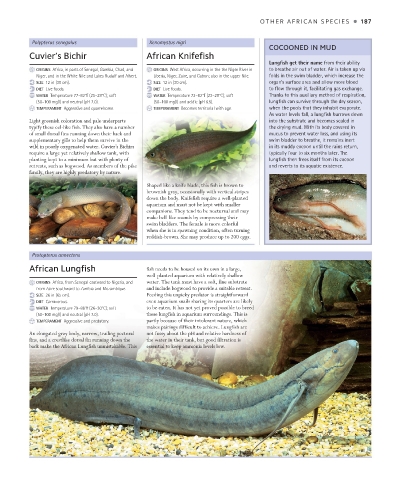
         An elongated gray body, narrow, trailing pectoral   not fussy about the pH and relative hardness of
         fins, and a crestlike dorsal fin running down the   the water in their tank, but good filtration is
         back make the African Lungfish unmistakable. This   essential to keep ammonia levels low.


   US_186-187_Oth_African_Sp.indd   187                                                              29/08/18   4:10 PM

