


Page 194 - Encyclopedia of Aquarium and Pond Fish, 3rd Edition
P. 194
192    FRESHWATER PLANT DIRECTORY

         FLOATING PLANTS


         Floating plants are chosen less for their appearance
         than those growing in the main body of the tank and
         more for their function. They provide spawning sites
         and food for many fish species and also give cover
         and help to diffuse harsh aquarium lighting.
         Floating plants vary widely in both size
         and leaf shape, and some grow on
         land as well as in water. Currents
         in the tank have a marked effect
         on the distribution of floating
         plants, so you may have to adjust the
         filter outlet to achieve an even spread.
         The choice of aquatic plants may be affected by
         legislation depending on where you live, because of fears
         that some could become invasive if introduced to native
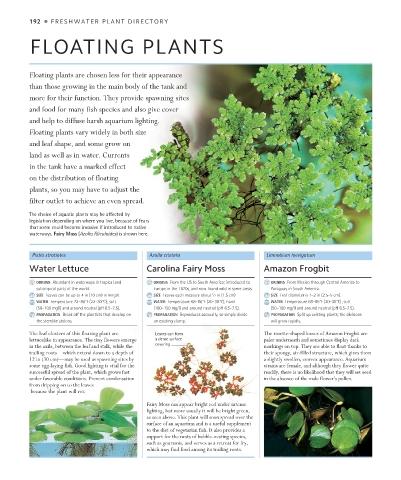
         waterways. Fairy Moss (Azolla filiculoides) is shown here.

          Pistia stratiotes               Azolla cristata                 Limnobium laevigatum
         Water Lettuce                   Carolina Fairy Moss              Amazon Frogbit

           ORIGINS  Abundant in waterways in tropical and   ORIGINS  From the US to South America; introduced to   ORIGINS  From Mexico through Central America to
           subtropical parts of the world.  Europe in the 1870s, and now found wild in some areas.  Paraguay in South America.
           SIZE  Leaves can be up to 4 in (10 cm) in length.  SIZE  Leaves each measure about  ⁄2 in (1.5 cm).   SIZE  Leaf diameter is 1–2 in (2.5–5 cm).
                                                            1
           WATER  Temperature 72–86°F (22–30°C); soft    WATER  Temperature 68–86°F (20–30°C); hard    WATER  Temperature 68–86°F (20–30°C); soft
           (50–100 mg/l) and around neutral (pH 6.5–7.5).  (100–150 mg/l) and around neutral (pH 6.5–7.5).  (50–100 mg/l) and around neutral (pH 6.5–7.5).
           PROPAGATION  Break off the plantlets that develop on   PROPAGATION  Reproduces asexually, so simply divide    PROPAGATION  Split up existing plants; the divisions
           the stemlike stolons.           an existing clump.               will grow rapidly.
         The leaf clusters of this floating plant are    Leaves can form   The rosette-shaped leaves of Amazon Frogbit are
         lettucelike in appearance. The tiny flowers emerge   a dense surface   paler underneath and sometimes display dark
         in the axils, between the leaf and stalk, while the   covering   markings on top. They are able to float thanks to
         trailing roots—which extend down to a depth of                   their spongy, air-filled structure, which gives them
         12 in (30 cm)—may be used as spawning sites by                   a slightly swollen, convex appearance. Aquarium
         some egg-laying fish. Good lighting is vital for the             strains are female, and although they flower quite
         successful spread of the plant, which grows fast                 readily, there is no likelihood that they will set seed
         under favorable conditions. Prevent condensation                 in the absence of the male flower’s pollen.
         from dripping on to the leaves
          because the plant will rot.
                                         Fairy Moss can appear bright red under intense
                                         lighting, but more usually it will be bright green,
                                         as seen above. This plant will soon spread over the
                                         surface of an aquarium and is a useful supplement
                                         to the diet of vegetarian fish. It also provides a
                                         support for the nests of bubble-nesting species,
                                         such as gouramis, and serves as a retreat for fry,
                                         which may find food among its trailing roots.


   US_192-193_Floating_Plants.indd   192                                                             29/08/18   4:10 PM

