


Page 195 - Encyclopedia of Aquarium and Pond Fish, 3rd Edition
P. 195
FLOATING PLANTS    193


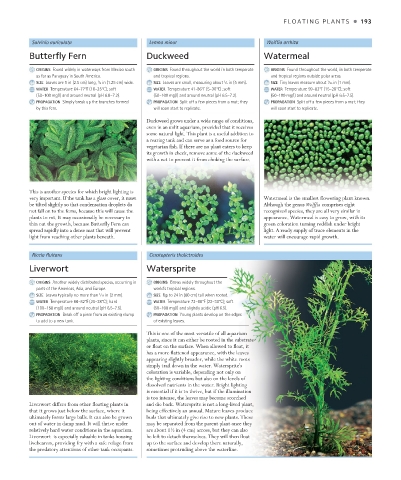
          Salvinia auriculata             Lemna minor                     Wolffia arrhiza
         Butterfly Fern                  Duckweed                         Watermeal

           ORIGINS  Found widely in waterways from Mexico south   ORIGINS  Found throughout the world in both temperate   ORIGINS  Found throughout the world, in both temperate
           as far as Paraguay in South America.   and tropical regions.     and tropical regions outside polar areas.
           SIZE  Leaves are 1 in (2.5 cm) long,  ⁄2 in (1.25 cm) wide.  SIZE  Leaves are small, measuring about  ⁄5 in (5 mm).  SIZE  Tiny leaves measure about  ⁄25 in (1 mm).
                                                               1
                            1
                                                                                           1
           WATER  Temperature 64–77°F (18–25°C); soft   WATER  Temperature 41-86°F (5–30°C); soft   WATER  Temperature 59–82°F (15–28°C); soft
           (50–100 mg/l) and around neutral (pH 6.8–7.2).  (50–100 mg/l) and around neutral (pH 6.5–7.2).  (50–100 mg/l) and around neutral (pH 6.5–7.5).
           PROPAGATION  Simply break up the branches formed   PROPAGATION  Split off a few pieces from a mat; they   PROPAGATION  Split off a few pieces from a mat; they
           by this fern.                   will soon start to replicate.    will soon start to replicate.
                                         Duckweed grows under a wide range of conditions,
                                         even in an unlit aquarium, provided that it receives
                                         some natural light. This plant is a useful addition to
                                         a rearing tank and can serve as a food source for
                                         vegetarian fish. If there are no plant eaters to keep
                                         its growth in check, remove some of the duckweed
                                         with a net to prevent it from choking the surface.


         This is another species for which bright lighting is
         very important. If the tank has a glass cover, it must           Watermeal is the smallest flowering plant known.
         be tilted slightly so that condensation droplets do              Although the genus Wolffia comprises eight
         not fall on to the ferns, because this will cause the            recognized species, they are all very similar in
         plants to rot. It may occasionally be necessary to               appearance. Watermeal is easy to grow, with its
         thin out the growth, because Butterfly Fern can                  green coloration turning reddish under bright
         spread rapidly into a dense mat that will prevent                light. A ready supply of trace elements in the
         light from reaching other plants beneath.                        water will encourage rapid growth.

          Riccia fluitans                 Ceratopteris thalictroides
         Liverwort                       Watersprite

           ORIGINS  Another widely distributed species, occurring in   ORIGINS  Grows widely throughout the
           parts of the Americas, Asia, and Europe.  world’s tropical regions.
           SIZE  Leaves typically no more than  ⁄12 in (2 mm).  SIZE  Up to 24 in (60 cm) tall when rooted.
                            1
           WATER  Temperature 68–82°F (20–28°C); hard  WATER  Temperature 72–86°F (22–30°C); soft
           (100–150 mg/l) and around neutral (pH 6.5–7.5).  (50–100 mg/l) and slightly acidic (pH 6.5).
           PROPAGATION  Break off a piece from an existing clump   PROPAGATION  Young plants develop on the edges
           to add to a new tank.           of existing leaves.
                                         This is one of the most versatile of all aquarium
                                         plants, since it can either be rooted in the substrate
                                         or float on the surface. When allowed to float, it
                                         has a more flattened appearance, with the leaves
                                         appearing slightly broader, while the white roots
                                         simply trail down in the water. Watersprite’s
                                         coloration is variable, depending not only on
                                         the lighting conditions but also on the levels of
                                         dissolved nutrients in the water. Bright lighting
                                         is essential if it is to thrive, but if the illumination
                                         is too intense, the leaves may become scorched
         Liverwort differs from other floating plants in   and die back. Watersprite is not a long-lived plant,
         that it grows just below the surface, where it   being effectively an annual. Mature leaves produce
         ultimately forms large balls. It can also be grown   buds that ultimately give rise to new plants. These
         out of water in damp mud. It will thrive under   may be separated from the parent plant once they
                                                1
         relatively hard water conditions in the aquarium.   are about 1 ⁄2 in (4 cm) across, but they can also
         Liverwort  is especially valuable in tanks housing   be left to detach themselves. They will then float
         livebearers, providing fry with a safe refuge from   up to the surface and develop there naturally,
         the predatory attentions of other tank occupants.  sometimes protruding above the waterline.


   US_192-193_Floating_Plants.indd   193                                                             29/08/18   4:10 PM

