


Page 196 - Encyclopedia of Aquarium and Pond Fish, 3rd Edition
P. 196
194    FRESHWATER PLANT DIRECTORY

         SUBSTRATE PLANTS


         Hundreds of plants are available to the freshwater
         aquarist, and selecting the right species means
         matching the optimum conditions for the
         plants to the needs of your fish. Plants and fish
         should share water chemistry needs and thrive
         under the same lighting conditions. Themed tanks,
         in which the geographical origins of fish and plants
         are matched, can work well. If your tank fish
         browse on vegetation, avoid slow-growing plants,
         which will not recover quickly enough;
         similarly, avoid prolific species that
         will soon outgrow a small tank.
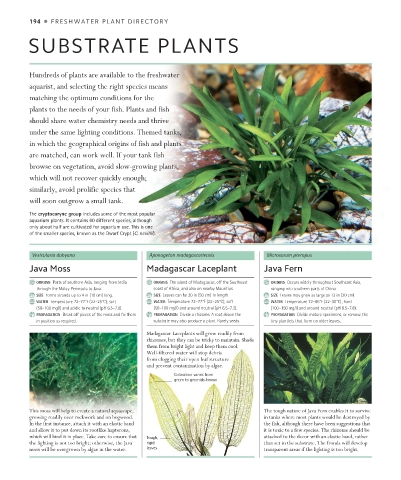
         The cryptocoryne group includes some of the most popular
         aquarium plants. It contains 60 different species, although
         only about half are cultivated for aquarium use. This is one
         of the smaller species, known as the Dwarf Crypt (C. nevillii).

          Vesicularia dubyana             Aponogeton madagascariensis     Microsorum pteropus
         Java Moss                       Madagascar Laceplant             Java Fern

           ORIGINS  Parts of southern Asia, ranging from India   ORIGINS  The island of Madagascar, off the Southeast   ORIGINS  Occurs widely throughout Southeast Asia,
           through the Malay Peninsula to Java.   coast of Africa, and also on nearby Mauritius.  ranging into southern parts of China.
           SIZE  Forms strands up to 4 in (10 cm) long.  SIZE  Leaves can be 20 in (50 cm) in length.  SIZE  Leaves may grow as large as 12 in (30 cm).
           WATER  Temperature 72–77°F (22–25°C); soft   WATER  Temperature 72–77°F (22–25°C); soft  WATER  Temperature 72–86°F (22–30°C); hard
           (50–100 mg/l) and acidic to neutral (pH 6.5–7.0).  (50–100 mg/l) and around neutral (pH 6.5–7.2).  (100–150 mg/l) and around neutral (pH 6.5–7.8).
           PROPAGATION  Break off pieces of the moss and fix them   PROPAGATION  Divide a rhizome. A root above the   PROPAGATION  Divide mature specimens, or remove the
           in position as required.        substrate may also produce a plant. Rarely seeds.  tiny plantlets that form on older leaves.
                                         Madagascar Laceplants will grow readily from
                                         rhizomes, but they can be tricky to maintain. Shade
                                         them from bright light and keep them cool.
                                         Well-filtered water will stop debris
                                         from clogging their open leaf structure
                                         and prevent contamination by algae.
                                                 Coloration varies from
                                                 green to greenish-brown


         This moss will help to create a natural aquascape,               The tough nature of Java Fern enables it to survive
         growing readily over rockwork and on bogwood.                    in tanks where most plants would be destroyed by
         In the first instance, attach it with an elastic band            the fish, although there have been suggestions that
         and allow it to put down its rootlike hapterons,                 it is toxic to a few species. The rhizome should be
         which will bind it in place. Take care to ensure that   Tough,   attached to the decor with an elastic band, rather
         the lighting is not too bright; otherwise, the Java   rigid      than set in the substrate. The fronds will develop
         moss will be overgrown by algae in the water.  leaves            transparent areas if the lighting is too bright.


   US_194-195_Substrate_Plants.indd   194                                                            29/08/18   4:10 PM

