


Page 197 - Encyclopedia of Aquarium and Pond Fish, 3rd Edition
P. 197
SUBSTRATE PLANTS     195


          Rotala macrandra                Crinum thaianum
         Giant Red Rotala                Onion Plant

           ORIGINS  Asia, occurring in India and on the nearby   ORIGINS  Southeast Asia; particularly abundant
           island of Sri Lanka.            in southern Thailand.
           SIZE  Typically about 8 in (20 cm) tall in aquariums.  SIZE  Leaves can be up to 60 in (1.5 m) long.
           WATER  Temperature 72–79°F (22–26°C); soft    WATER  Temperature 64–81°F (18–27°C); hard
           (50–100 mg/l) and acidic (pH 6.5–6.9).  (100–150 mg/l) and around neutral (pH 6.5–7.5).
           PROPAGATION  Split off shoots and plant these in the   PROPAGATION  May occasionally develop offsets on the
           substrate, where they will root easily.  bulb; these can be taken off and replanted.
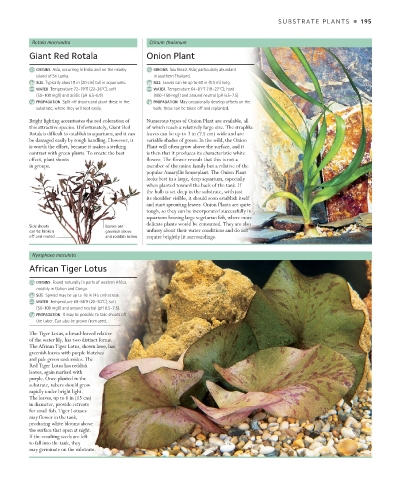
         Bright lighting accentuates the red coloration of   Numerous types of Onion Plant are available, all
         this attractive species. Unfortunately, Giant Red   of which reach a relatively large size. The straplike
         Rotala is difficult to establish in aquariums, and it can   leaves can be up to 3 in (7.5 cm) wide and are
         be damaged easily by rough handling. However, it   variable shades of green. In the wild, the Onion
         is worth the effort, because it makes a striking   Plant will often grow above the surface, and it
         contrast with green plants. To create the best   is then that it produces its characteristic white
         effect, plant shoots            flower. The flower reveals that this is not a
         in groups.                      member of the onion family but a relative of the
                                         popular Amaryllis houseplant. The Onion Plant
                                         looks best in a large, deep aquarium, especially
                                         when planted toward the back of the tank. If
                                         the bulb is set deep in the substrate, with just
                                         its shoulder visible, it should soon establish itself
                                         and start sprouting leaves. Onion Plants are quite
                                         tough, so they can be incorporated successfully in
                                         aquariums housing large vegetarian fish, where more
                                         delicate plants would be consumed. They are also
         Side shoots          Leaves are
         can be broken        greenish above   unfussy about their water conditions and do not
         off and rooted       and reddish below  require brightly lit surroundings.
          Nymphaea maculata
         African Tiger Lotus

           ORIGINS  Found naturally in parts of western Africa,
           notably in Gabon and Congo.
           SIZE  Spread may be up to 18 in (45 cm) across.
           WATER  Temperature 68–86°F (20–30°C); soft
           (50–100 mg/l) and around neutral (pH 6.5–7.5).
           PROPAGATION  It may be possible to take shoots off
           the tuber. Can also be grown from seed.
         The Tiger Lotus, a broad-leaved relative
         of the water lily, has two distinct forms.
         The African Tiger Lotus, shown here, has
         greenish leaves with purple blotches
         and pale green undersides. The
         Red Tiger Lotus has reddish
         leaves, again marked with
         purple. Once planted in the
         substrate, tubers should grow
         rapidly under bright light.
         The leaves, up to 6 in (15 cm)
         in diameter, provide retreats
         for small fish. Tiger Lotuses
         may flower in the tank,
         producing white blooms above
         the surface that open at night.
         If the resulting seeds are left
         to fall into the tank, they
         may germinate on the substrate.


   US_194-195_Substrate_Plants.indd   195                                                            29/08/18   4:10 PM

