


Page 198 - Encyclopedia of Aquarium and Pond Fish, 3rd Edition
P. 198
196    FRESHWATER PLANT DIRECTORY


          Barclaya longifolia             Bacopa caroliniana              Glossostigma elatinoides
         Orchid Lily                     Giant Red Bacopa                 Glosso

           ORIGINS  Southeast Asia, occurring from Myanmar   ORIGINS  Found naturally from southern parts of the   ORIGINS  Found in Australia, in New South Wales and
           (Burma) to parts of Thailand and Malaysia.  United States into northern Mexico.  Tasmania, and also in New Zealand.
           SIZE  Up to 12 in (30 cm) across.  SIZE  Stems can grow up to 12 in (30 cm) long.  SIZE  About 1 in (2.5 cm) in height.
           WATER  Temperature 77–86°F (25–30°C); soft   WATER  Temperature 68–75°F (20–24°C); hard   WATER  Temperature 68–82°F (20–28°C); soft
           (50–100 mg/l) and around neutral (pH 6.8–7.2).  (100–150 mg/l) and around neutral (pH 6.5–7.5).  (50–100 mg/l) and around neutral (pH 6.5–7.5).
           PROPAGATION  Small plantlets on the rhizome can be   PROPAGATION  Strip off the lower two pairs of leaves   PROPAGATION  Clumps can be split up and used as
           split off and planted. May also be propagated from seed.  from the stem and plant in the substrate as a clump.  cuttings. Alternatively, runners can be used.
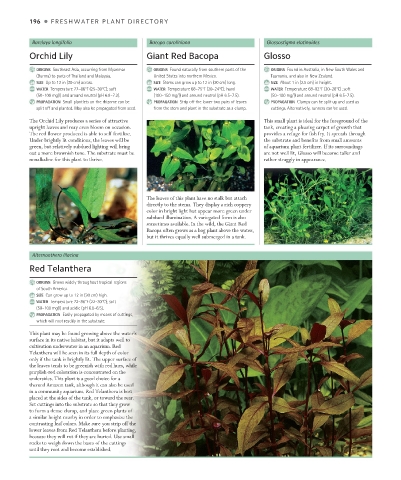
         The Orchid Lily produces a series of attractive                  This small plant is ideal for the foreground of the
         upright leaves and may even bloom on occasion.                   tank, creating a pleasing carpet of growth that
         The red flower produced is able to self-fertilize.               provides a refuge for fish fry. It spreads through
         Under brightly lit conditions, the leaves will be                the substrate and benefits from small amounts
         green, but relatively subdued lighting will bring                of aquarium plant fertilizer. If its surroundings
         out a more brownish tone. The substrate must be                  are not well lit, Glosso will become taller and
         nonalkaline for this plant to thrive.                            rather straggly in appearance.


                                         The leaves of this plant have no stalk but attach
                                         directly to the stems. They display a rich coppery
                                         color in bright light but appear more green under
                                         subdued illumination. A variegated form is also
                                         sometimes available. In the wild, the Giant Red
                                         Bacopa often grows as a bog plant above the water,
                                         but it thrives equally well submerged in a tank.

          Alternanthera lilacina
         Red Telanthera

           ORIGINS  Grows widely throughout tropical regions
           of South America.
           SIZE  Can grow up to 12 in (30 cm) high.
           WATER  Temperature 72–86°F (22–30°C); soft
           (50–100 mg/l) and acidic (pH 6.0–6.5).
           PROPAGATION  Easily propagated by means of cuttings,
           which will root readily in the substrate.
         This plant may be found growing above the water’s
         surface in its native habitat, but it adapts well to
         cultivation underwater in an aquarium. Red
         Telanthera will be seen in its full depth of color
         only if the tank is brightly lit. The upper surface of
         the leaves tends to be greenish with red hues, while
         purplish-red coloration is concentrated on the
         undersides. This plant is a good choice for a
         themed Amazon tank, although it can also be used
         in a community aquarium. Red Telanthera is best
         placed at the sides of the tank, or toward the rear.
         Set cuttings into the substrate so that they grow
         to form a dense clump, and place green plants of
         a similar height nearby in order to emphasize the
         contrasting leaf colors. Make sure you strip off the
         lower leaves from Red Telanthera before planting,
         because they will rot if they are buried. Use small
         rocks to weigh down the bases of the cuttings
         until they root and become established.


   US_196-197_Substrate_Plants.indd   196                                                            29/08/18   4:10 PM

