


Page 253 - Encyclopedia of Aquarium and Pond Fish, 3rd Edition
P. 253
BOXFISH AND PORCUPINEFISH    251


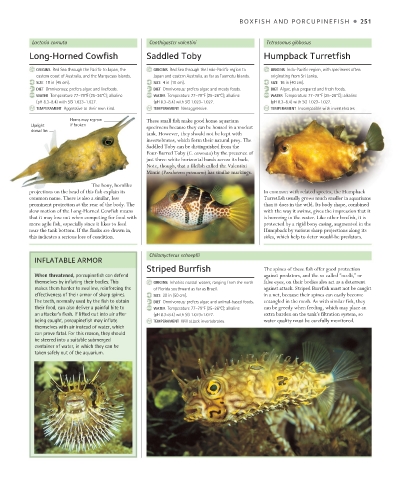
          Lactoria cornuta                Canthigaster valentini          Tetrosomus gibbosus
         Long-Horned Cowfish             Saddled Toby                     Humpback Turretfish

           ORIGINS  Red Sea through the Pacific to Japan, the   ORIGINS  Red Sea through the Indo-Pacific region to   ORIGINS  Indo-Pacific region, with specimens often
           eastern coast of Australia, and the Marquesas Islands.   Japan and eastern Australia, as far as Tuamotu Islands.  originating from Sri Lanka.
           SIZE  18 in (45 cm).            SIZE  4 in (10 cm).              SIZE  16 in (40 cm).
           DIET  Omnivorous; prefers algae and livefoods.   DIET  Omnivorous; prefers algae and meaty foods.   DIET  Algae, plus prepared and fresh foods.
           WATER  Temperature 77–79°F (25–26°C); alkaline   WATER  Temperature 77–79°F (25–26°C); alkaline   WATER  Temperature 77–79°F (25–26°C); alkaline
           (pH 8.3–8.4) with SG 1.023–1.027.   (pH 8.3–8.4) with SG 1.023–1.027.  (pH 8.3–8.4) with SG 1.023–1.027.
           TEMPERAMENT  Aggressive to their own kind.  TEMPERAMENT  Nonaggressive.  TEMPERAMENT  Incompatible with invertebrates.
                    Horns may regrow     These small fish make good home aquarium
          Upright   if broken            specimens because they can be housed in a modest
          dorsal fin
                                         tank. However, they should not be kept with
                                         invertebrates, which form their natural prey. The
                                         Saddled Toby can be distinguished from the
                                         Four-Barred Toby (C. coronata) by the presence of
                                         just three white horizontal bands across its back.
                                         Note, though, that a filefish called the Valentini
                                         Mimic (Paraluteres prionurus) has similar markings.
                          The bony, hornlike
         projections on the head of this fish explain its                 In common with related species, the Humpback
         common name. There is also a similar, less                       Turretfish usually grows much smaller in aquariums
         prominent projection at the rear of the body. The                than it does in the wild. Its body shape, combined
         slow motion of the Long-Horned Cowfish means                     with the way it swims, gives the impression that it
         that it may lose out when competing for food with                is hovering in the water. Like other boxfish, it is
         more agile fish, especially since it likes to feed               protected by a rigid bony casing, augmented in the
         near the tank bottom. If the flanks are drawn in,                Humpback by various sharp projections along its
         this indicates a serious loss of condition.                      sides, which help to deter would-be predators.

                                          Chilomycterus schoepfii
           INFLATABLE ARMOR
                                         Striped Burrfish                 The spines of these fish offer good protection
           When threatened, porcupinefish can defend                      against predators, and the so-called “ocelli,” or
           themselves by inflating their bodies. This    ORIGINS  Inhabits coastal waters, ranging from the north   false eyes, on their bodies also act as a deterrent
           makes them harder to swallow, reinforcing the   of Florida southward as far as Brazil.   against attack. Striped Burrfish must not be caught
           effectiveness of their armor of sharp spines.   SIZE  20 in (50 cm).  in a net, because their spines can easily become
           The teeth, normally used by the fish to obtain   DIET  Omnivorous; prefers algae and animal-based foods.  entangled in the mesh. As with similar fish, they
           their food, can also deliver a painful bite to    WATER  Temperature 77–79°F (25–26°C); alkaline   can be greedy when feeding, which may place an
           an attacker’s flesh. If lifted out into air after   (pH 8.3–8.4) with SG 1.023–1.027.   extra burden on the tank’s filtration system, so
           being caught, porcupinefish may inflate   TEMPERAMENT  Will attack invertebrates.  water quality must be carefully monitored.
           themselves with air instead of water, which
           can prove fatal. For this reason, they should
           be steered into a suitable submerged
           container of water, in which they can be
           taken safely out of the aquarium.


   US_250-251_Box_Cow_Pufferfish.indd   251                                                          29/08/18   4:10 PM

