


Page 254 - Encyclopedia of Aquarium and Pond Fish, 3rd Edition
P. 254
252    MARINE FISH DIRECTORY

         ANGELFISH


         The angelfish family includes some of the most attractively
         patterned of all reef fish. The size of angelfish can vary
         greatly between species. While dwarf angelfish (Centropyge
         species) attain a maximum length of 5 in (12.5 cm), their
         larger relatives may grow as large as 24 in (60 cm) in
         the wild. The young of these bigger species often differ
         significantly in appearance from the adults. Bear this in
         mind when choosing young angelfish for the aquarium,
         and never base your choice simply on size, because
         you could easily end up buying a juvenile that rapidly
         outgrows its accommodation. Larger species are also
         more quarrelsome than their smaller relatives and not
         generally suited to being housed with invertebrates.
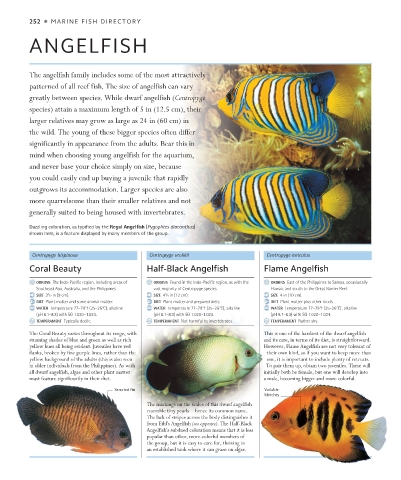
         Dazzling coloration, as typified by the Regal Angelfish (Pygoplites diacanthus)
         shown here, is a feature displayed by many members of the group.

          Centropyge bispinosa            Centropyge vrolikii             Centropyge loriculus
         Coral Beauty                    Half-Black Angelfish             Flame Angelfish

           ORIGINS  The Indo-Pacific region, including areas of   ORIGINS  Found in the Indo-Pacific region, as with the   ORIGINS  East of the Philippines to Samoa, occasionally
           Southeast Asia, Australia, and the Philippines.   vast majority of Centropyge species.  Hawaii, and south to the Great Barrier Reef.
           SIZE  3 ⁄2 in (9 cm).           SIZE  4 ⁄4 in (12 cm).           SIZE  4 in (10 cm).
              1
                                               3
           DIET  Plant matter and some animal matter.   DIET  Plant matter and prepared diets.  DIET  Plant matter plus other foods.
           WATER  Temperature 77–79°F (25–26°C); alkaline    WATER  Temperature 77–79°F (25–26°C); alkaline    WATER  Temperature 77–79°F (25–26°C); alkaline
           (pH 8.1–8.3) with SG 1.020–1.024.  (pH 8.1–8.3) with SG 1.020–1.024.  (pH 8.1–8.3) with SG 1.020–1.024.
           TEMPERAMENT  Typically docile.  TEMPERAMENT  Not harmful to invertebrates.  TEMPERAMENT  Rather shy.
         The Coral Beauty varies throughout its range, with               This is one of the hardiest of the dwarf angelfish
         stunning shades of blue and green as well as rich                and its care, in terms of its diet, is straightforward.
         yellow hues all being evident. Juveniles have red                However, Flame Angelfish are not very tolerant of
         flanks, broken by fine purple lines, rather than the              their own kind, so if you want to keep more than
         yellow background of the adults (this is also seen                one, it is important to include plenty of retreats.
         in older individuals from the Philippines). As with              To pair them up, obtain two juveniles. These will
         all dwarf angelfish, algae and other plant matter                initially both be female, but one will develop into
         must feature significantly in their diet.                        a male, becoming bigger and more colorful.
                                 Serrated fin                             Variable
                                                                          blotches
                                         The markings on the scales of this dwarf angelfish
                                         resemble tiny pearls—hence its common name.
                                         The lack of stripes across the body distinguishes it
                                         from Eibl’s Angelfish (see opposite). The Half-Black
                                         Angelfish’s subdued coloration means that it is less
                                         popular than other, more colorful members of
                                         the group, but it is easy to care for, thriving in
                                         an established tank where it can graze on algae.


   US_252-253_Angelfish.indd   252                                                                   29/08/18   4:10 PM

