


Page 255 - Encyclopedia of Aquarium and Pond Fish, 3rd Edition
P. 255
ANGELFISH    253


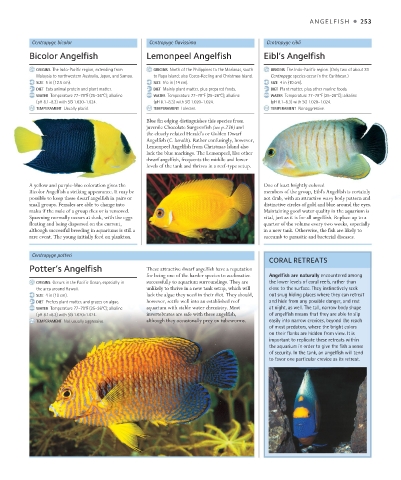
          Centropyge bicolor              Centropyge flavissima           Centropyge eibli
         Bicolor Angelfish               Lemonpeel Angelfish              Eibl’s Angelfish

           ORIGINS  The Indo-Pacific region, extending from   ORIGINS  North of the Philippines to the Marianas, south   ORIGINS  The Indo-Pacific region. (Only two of about 33
           Malaysia to northwestern Australia, Japan, and Samoa.   to Rapa Island; also Cocos-Keeling and Christmas Island.  Centropyge species occur in the Caribbean.)
                                               1
           SIZE  5 in (12.5 cm).           SIZE  5 ⁄2 in (14 cm).           SIZE  4 in (10 cm).
           DIET  Eats animal protein and plant matter.  DIET  Mainly plant matter, plus prepared foods.  DIET  Plant matter, plus other marine foods.
           WATER  Temperature 77–79°F (25–26°C); alkaline    WATER  Temperature 77–79°F (25–26°C); alkaline    WATER  Temperature 77–79°F (25–26°C); alkaline
           (pH 8.1–8.3) with SG 1.020–1.024.  (pH 8.1–8.3) with SG 1.020–1.024.  (pH 8.1–8.3) with SG 1.020–1.024.
           TEMPERAMENT  Usually placid.    TEMPERAMENT  Tolerant.           TEMPERAMENT  Nonaggressive.
                                         Blue fin edging distinguishes this species from
                                         juvenile Chocolate Surgeonfish (see p.236) and
                                         the closely related Herald’s or Golden Dwarf
                                         Angelfish (C. heraldi). Rather confusingly, however,
                                         Lemonpeel Angelfish from Christmas Island also
                                         lack the blue markings. The Lemonpeel, like other
                                         dwarf angelfish, frequents the middle and lower
                                         levels of the tank and thrives in a reef-type setup.

         A yellow and purple-blue coloration gives the                    One of least brightly colored
         Bicolor Angelfish a striking appearance. It may be               members of the group, Eibl’s Angelfish is certainly
         possible to keep these dwarf angelfish in pairs or               not drab, with an attractive wavy body pattern and
         small groups. Females are able to change into                    distinctive circles of gold and blue around the eyes.
         males if the male of a group dies or is removed.                 Maintaining good water quality in the aquarium is
         Spawning normally occurs at dusk, with the eggs                  vital, just as it is for all angelfish. Replace up to a
         floating and being dispersed on the current,                     quarter of the volume every two weeks, especially
         although successful breeding in aquariums is still a             in a new tank. Otherwise, the fish are likely to
         rare event. The young initially feed on plankton.                succumb to parasitic and bacterial diseases.

          Centropyge potteri
                                                                           CORAL RETREATS
         Potter’s Angelfish              These attractive dwarf angelfish have a reputation
                                         for being one of the harder species to acclimatize   Angelfish are naturally encountered among
           ORIGINS  Occurs in the Pacific Ocean, especially in    successfully to aquarium surroundings. They are   the lower levels of coral reefs, rather than
           the area around Hawaii.       unlikely to thrive in a new tank setup, which will   close to the surface. They instinctively seek
           SIZE  4 in (10 cm).           lack the algae they need in their diet. They should,   out snug hiding places where they can retreat
           DIET  Prefers plant matter, and grazes on algae.   however, settle well into an established reef   and hide from any possible danger, and rest
           WATER  Temperature 77–79°F (25–26°C); alkaline    aquarium with stable water chemistry. Most   at night, as well. The tall, narrow body shape
           (pH 8.1–8.3) with SG 1.020–1.024.  invertebrates are safe with these angelfish,   of angelfish means that they are able to slip
           TEMPERAMENT  Not usually aggressive.  although they occasionally prey on tubeworms.  easily into narrow crevices, beyond the reach
                                                                           of most predators, where the bright colors
                                                                           on their flanks are hidden from view. It is
                                                                           important to replicate these retreats within
                                                                           the aquarium in order to give the fish a sense
                                                                           of security. In the tank, an angelfish will tend
                                                                           to favor one particular crevice as its retreat.


   US_252-253_Angelfish.indd   253                                                                   29/08/18   4:10 PM

