


Page 288 - Encyclopedia of Aquarium and Pond Fish, 3rd Edition
P. 288
286    MARINE INVERTEBRATES DIRECTORY

         SPONGES AND ANEMONES


         These invertebrates are an integral part of the reef
         ecosystem. Anemones are soft-bodied creatures
         with flowing, stinging tentacles for catching prey.
         Sponges have a more rigid body structure and are
         filter-feeders. Both are sometimes known as
         sessile invertebrates because, like corals, they
         anchor themselves to the reef. Sponges build
         up their body casing from minerals, such as
         calcium and silica, combined with a jellylike
         substance called spongin. As a sponge grows, it
         is possible to take off pieces and establish these
         “cuttings” elsewhere. Anemones reproduce either
         sexually or asexually, depending on the species.
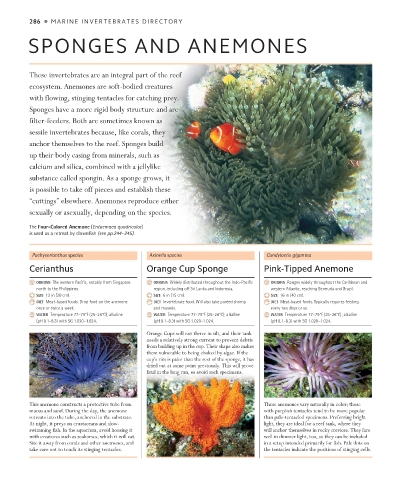
         The Four-Colored Anemone (Entacmaea quadricolor)
         is used as a retreat by clownfish (see pp.244–245).

          Pachycerianthus species         Axinella species                Condylactis gigantea
         Cerianthus                      Orange Cup Sponge                Pink-Tipped Anemone

           ORIGINS  The western Pacific, notably from Singapore   ORIGINS  Widely distributed throughout the Indo-Pacific   ORIGINS  Ranges widely throughout the Caribbean and
           north to the Philippines.       region, including off Sri Lanka and Indonesia.   western Atlantic, reaching Bermuda and Brazil.
           SIZE  12 in (30 cm).            SIZE  6 in (15 cm).              SIZE  16 in (40 cm).
           DIET  Meat-based foods. Drop food on the anemone    DIET  Invertebrate food. Will also take puréed shrimp    DIET  Meat-based foods. Typically requires feeding
           once or twice a week.           and mussels.                     every two days or so.
           WATER  Temperature 77–79°F (25–26°C); alkaline    WATER  Temperature 77–79°F (25–26°C); alkaline    WATER  Temperature 77–79°F (25–26°C); alkaline
           (pH 8.1–8.3) with SG 1.020–1.024.  (pH 8.1–8.3) with SG 1.020–1.024.  (pH 8.1–8.3) with SG 1.020–1.024.
                                         Orange Cups will not thrive in silt, and their tank
                                         needs a relatively strong current to prevent debris
                                         from building up in the cup. Their shape also makes
                                         them vulnerable to being choked by algae. If the
                                         cup’s rim is paler than the rest of the sponge, it has
                                         dried out at some point previously. This will prove
                                         fatal in the long run, so avoid such specimens.


         This anemone constructs a protective tube from                   These anemones vary naturally in color; those
         mucus and sand. During the day, the anemone                      with purplish tentacles tend to be more popular
         retreats into the tube, anchored in the substrate.               than pale-tentacled specimens. Preferring bright
         At night, it preys on crustaceans and slow-                      light, they are ideal for a reef tank, where they
         swimming fish. In the aquarium, avoid housing it                 will anchor themselves in rocky crevices. They fare
         with creatures such as seahorses, which it will eat.             well in dimmer light, too, so they can be included
         Site it away from corals and other anemones, and                 in a setup intended primarily for fish. Pale dots on
         take care not to touch its stinging tentacles.                   the tentacles indicate the positions of stinging cells.


   US_286-287_Sponges_Anemones.indd   286                                                            29/08/18   4:10 PM

